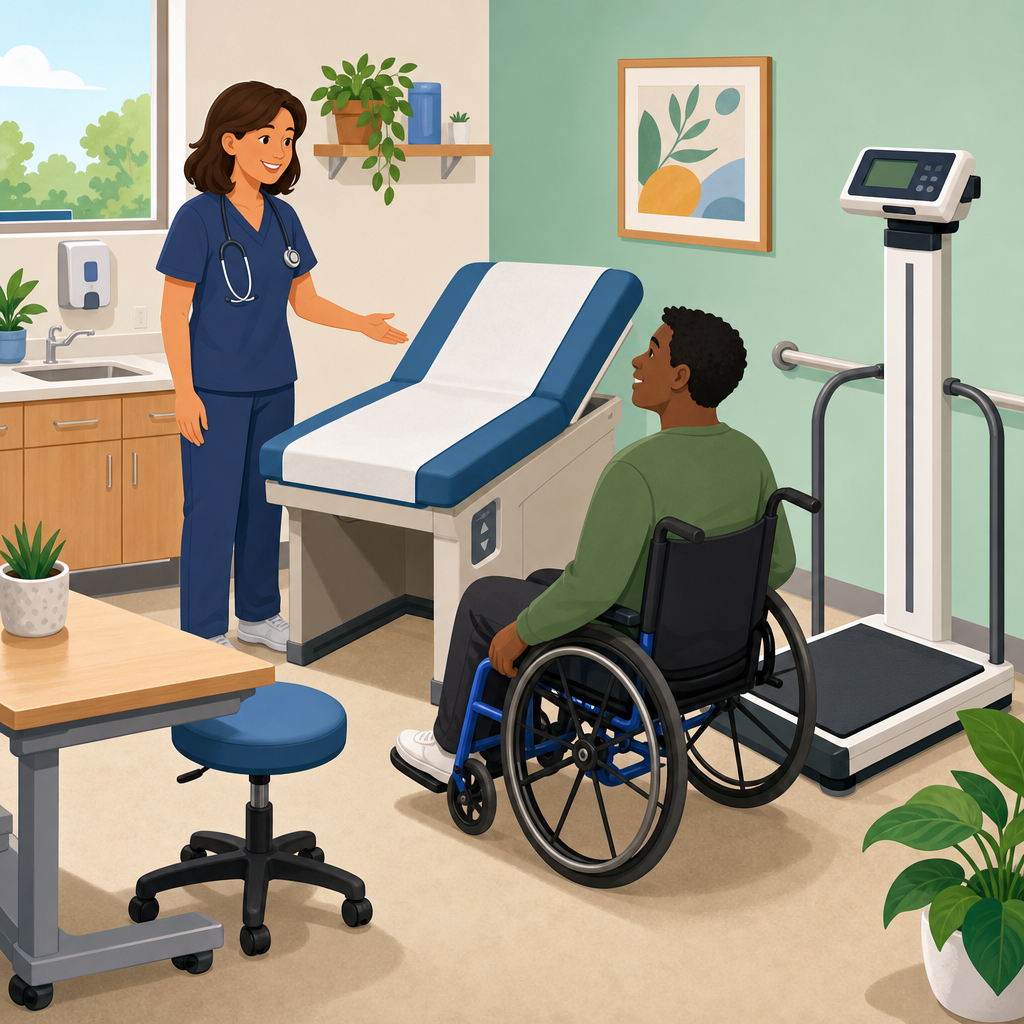
Accessible exam rooms, tables, and scales are foundational to equitable health care because they determine whether patients with disabilities can enter a room safely, transfer with dignity, be weighed accurately, and receive the same standard of assessment as everyone else. In health care settings, accessibility means more than adding a ramp at the front door. It includes the layout of the exam room, the adjustability of the exam table, the availability of a wheelchair-accessible scale, the reach range for supplies, the presence of transfer supports, and staff practices that allow disabled patients to participate in care without avoidable barriers. I have worked with clinics that assumed they were accessible because the lobby met basic building requirements, yet patients still skipped preventive visits because no one could weigh them, transfer them, or position them safely for an exam.
This matters clinically, legally, operationally, and ethically. A patient who cannot be weighed may receive the wrong medication dose. A patient who cannot get onto a fixed-height table may miss skin assessments, pelvic exams, wound checks, or cardiopulmonary exams that are difficult or impossible from a wheelchair. A patient forced into a risky manual lift may experience injury, humiliation, or both. Health systems also face compliance exposure under the Americans with Disabilities Act, Section 504 of the Rehabilitation Act, and, for many organizations, standards that shape facility design, procurement, and patient handling policies. The practical goal is straightforward: every patient should be able to enter the exam room, navigate it, transfer if needed, communicate preferences, and complete routine clinical processes without improvisation.
As a hub for healthcare accessibility, this guide explains what accessible exam rooms, accessible exam tables, and accessible wheelchair scales are, how they work together, and what health care leaders should evaluate across design, equipment, workflow, staff training, and procurement. It also points toward the broader healthcare topics every organization should connect internally, including accessible waiting areas, diagnostic imaging access, patient communication, restroom design, and emergency procedures. If your facility serves patients, accessibility in the exam room is not a specialty feature. It is core infrastructure for quality care.
What makes an exam room accessible in health care
An accessible exam room allows a patient with mobility, sensory, dexterity, or balance limitations to use the space with the same privacy, safety, and efficiency expected for any other patient. In practice, that starts with clear floor space and route width. Wheelchairs, scooters, and walkers need maneuvering room near the door, beside the exam table, and at turning points. Doors, hardware, and thresholds must be easy to use. Sinks, coat hooks, sharps containers, dispensers, and call buttons should fall within usable reach ranges. Lighting must support visual tasks without glare, and acoustics should allow private conversation for patients who rely on hearing aids or speech-reading.
Room layout is just as important as square footage. I have seen larger rooms fail because fixed cabinetry blocked side transfer access to the table, while smaller rooms performed well because the furniture plan was intentional. A good room provides transfer space next to the exam table, parking space for mobility devices, and unobstructed access to scales or lifts if those are housed in the room. It also anticipates companions, interpreters, service animals, and portable equipment. The best design removes the need for staff to “make it work” on the spot. When the room is planned correctly, accessibility becomes routine instead of exceptional.
Accessible exam rooms also depend on operations. Scheduling systems should flag equipment needs without labeling the patient as a problem. Staff should know which room contains the height-adjustable table, where transfer boards are stored, and how to prepare before the patient arrives. If only one room is accessible, bottlenecks are inevitable. For primary care, specialty care, urgent care, and outpatient clinics, the reliable standard is to distribute accessibility across the practice rather than isolate it.
Accessible exam tables: features, uses, and selection criteria
An accessible exam table is typically height adjustable, stable, and designed to support safer transfers from a wheelchair or mobility device. Low transfer height is the most important feature. A table that lowers to wheelchair-seat height can dramatically reduce transfer difficulty and fall risk. Adjustable backrests, stirrups or positioning accessories when clinically needed, side rails used appropriately, and sufficient working load capacity all matter. For many populations, powered height adjustment is essential because manual systems are too slow, inconsistent, or physically demanding for staff to use correctly during a busy clinic session.
Fixed-height tables are a common failure point. They may be inexpensive upfront, but they create clinical compromise. Staff often perform incomplete exams with the patient seated in a wheelchair, not because it is best practice but because the table is unusable. That workaround can affect blood pressure positioning, abdominal palpation, foot exams, dermatology checks, gynecologic care, and procedures that require supine or side-lying positioning. In women’s health, orthopedics, neurology, and wound care, table accessibility directly affects whether standard examinations are even possible.
When selecting exam tables, health care buyers should look beyond the brochure. Verify the lowest transfer height, width, patient weight capacity, transfer supports, paper roll placement, electrical requirements, maintenance intervals, and infection-control cleanability. Ask whether accessories can be added later and whether the vendor provides service coverage in your region. In my experience, procurement teams often focus on capital price and overlook uptime. A broken powered table turns an accessible room into an inaccessible one overnight, so service response time belongs in the purchasing decision.
| Equipment or feature | Why it matters | What to verify before purchase |
|---|---|---|
| Height-adjustable exam table | Enables safer lateral or assisted transfers and fuller clinical exams | Lowest height, stability, weight capacity, side access, service plan |
| Wheelchair-accessible scale | Provides accurate weights without forcing a transfer | Platform size, ramp slope, handrails, display visibility, calibration |
| Patient lift or transfer aid | Reduces injury risk when independent transfer is not possible | Compatibility with slings, storage space, staff training needs |
| Accessible room layout | Allows approach, turning, parking, and equipment use without obstruction | Clear floor space, door swing, reach ranges, furniture placement |
For many organizations, standardizing one or two accessible table models across clinics simplifies training, maintenance, and replacement parts. That consistency helps staff act quickly and confidently. The right table is not a luxury product. It is a clinical tool that protects patient dignity while improving exam quality.
Accessible scales: why accurate weight collection is a patient safety issue
Accessible scales are often treated as an afterthought, but they are central to safe care. Weight affects medication dosing, fluid management, nutrition assessment, chemotherapy planning, dialysis decisions, anesthesia considerations, and chronic disease monitoring. If a patient cannot step onto a standing scale and the clinic has no wheelchair-accessible scale, staff may estimate weight or skip it entirely. Estimation is not a minor inconvenience. It can produce significant dosing error, especially for pediatrics, oncology, anticoagulation management, and patients with heart failure or renal disease.
A wheelchair-accessible scale typically includes a low-profile platform or integrated ramp, sufficient platform dimensions, and a display readable by both patient and staff. Some models include handrails, foldable ramps, BMI calculation, EMR connectivity, or multifunction use with bariatric capacity. Calibration is critical. A scale that is physically accessible but poorly maintained still fails the patient. Organizations should follow manufacturer guidance and biomedical equipment protocols to ensure ongoing accuracy.
Placement matters as much as specification. If the scale is stored behind boxes, parked in a hallway used for carts, or located in a distant department that requires a separate escort, it will not be used consistently. In several clinics I have audited, the scale technically existed, but frontline staff avoided it because retrieving it added ten minutes and disrupted patient flow. The solution was not more reminders. It was workflow redesign: place the scale near intake, train staff on operation, and build weighing expectations into rooming procedures for patients who consent and clinically need it.
Transfer safety, patient handling, and staff training
Accessible equipment works only when staff know how to use it. Transfer safety should cover independent transfer, assisted standing pivot transfer, lateral transfer with a board, and lift-assisted transfer when appropriate. Staff need to ask the patient how they usually transfer, what support they use at home, and whether pain, spasticity, weakness, or recent surgery affects the plan. The patient is often the best source of practical instruction. Respectful communication prevents dangerous assumptions.
Manual lifting should not be the default. Safe patient handling programs, widely supported in hospitals and increasingly relevant in outpatient care, reduce musculoskeletal injury for staff and lower fall risk for patients. Depending on the setting, that may include gait belts, transfer boards, portable floor lifts, ceiling lifts, or sit-to-stand devices. Equipment selection should align with patient population. A neurology clinic, bariatric program, wound center, or rehabilitation practice will have different handling needs from a dermatology office, yet every site should have a plan for patients who cannot transfer independently.
Training should be hands-on, recurring, and role specific. Front-desk staff need scripts for scheduling and arrival. Medical assistants and nurses need competency on room setup, scale use, and transfer supports. Providers need to understand how to adapt exam technique without lowering standards. Facilities and biomedical teams need preventive maintenance schedules. Accessibility fails when knowledge is concentrated in one champion who happens to be off that day.
Design standards, regulations, and compliance priorities
Health care accessibility sits at the intersection of civil rights law, facility design requirements, equipment standards, and risk management. In the United States, the ADA and Section 504 establish broad obligations for equal access and nondiscrimination. The 2010 ADA Standards for Accessible Design govern many elements of the built environment, such as routes, doors, toilet rooms, and clear floor space. For medical diagnostic equipment, the U.S. Access Board has issued standards that address transfer height, transfer surface size, supports, and other criteria for certain equipment categories. Even when a particular standard is not directly enforced in the way building codes are, it provides a strong benchmark for procurement and program design.
Organizations should not confuse minimum code compliance with full clinical accessibility. A compliant doorway does not solve the absence of a height-adjustable table. Likewise, an accessible toilet room does not compensate for the lack of a wheelchair scale. Regulators, accrediting bodies, plaintiffs’ attorneys, and disability advocates increasingly focus on the patient journey as a whole. The defensible approach is comprehensive access: policy, space, equipment, communication, and training documented together.
For health systems managing multiple sites, an accessibility inventory is the best starting point. Document room dimensions, table types, scale types, transfer aids, signage, restroom access, and staff competencies. Then prioritize high-volume clinics, primary care, women’s health, orthopedics, oncology, and any site where inaccessible equipment routinely alters care. Capital planning should treat accessibility gaps as operational risk, not optional renovation items.
Building an accessible healthcare program across the patient journey
Exam rooms, tables, and scales are the center of this healthcare guide, but they are only one layer of access. A complete program links parking and drop-off, reception counters, waiting room seating, restroom access, wayfinding, patient portals, check-in kiosks, interpreters, consent forms, imaging suites, mammography, dental and vision equipment, and emergency evacuation procedures. If one link fails, the visit can still break down. That is why this page functions as a hub for the healthcare subtopic: every related article should connect back to the exam room because that is where accessibility becomes tangible to the patient.
Operationally, strong programs share a few habits. They include disabled patients in planning and feedback. They write procurement specifications instead of relying on generic vendor claims. They use preventive maintenance and replacement cycles. They monitor complaints, missed weights, incomplete exams, and transfer incidents. They also track simple measures that reveal progress, such as the percentage of clinics with at least one powered low-height table per pod, the percentage with an accessible scale in routine use, and the percentage of staff current on transfer competency.
The business case is real, but the care case is stronger. Accessible health care improves preventive screening, chronic disease management, patient satisfaction, and staff safety. It reduces avoidable improvisation and helps clinicians deliver complete exams instead of partial substitutes. Most importantly, it signals respect. Patients notice immediately whether a facility planned for their presence or treated it as an exception.
Accessible exam rooms, accessible exam tables, and accessible scales are not isolated purchases. They are the physical proof that a healthcare organization intends to provide equal care. Start by auditing your current rooms, equipment, and workflows. Identify where patients cannot transfer safely, cannot be weighed accurately, or cannot receive a full exam. Upgrade the room layout, replace fixed-height tables with powered low-height models where needed, install wheelchair-accessible scales in routine care areas, and train staff to use every tool consistently. Then connect those improvements to the rest of your healthcare accessibility program so that scheduling, intake, communication, diagnostics, and follow-up support the same standard.
The key takeaway is simple: accessibility in health care is measurable. You can see it in transfer height, turning space, calibrated scales, documented competencies, and patient feedback. When those elements are in place, quality improves for patients and staff alike. Use this guide as the hub for your healthcare accessibility work, then move from assessment to action. Review one clinic this month, fix the highest-risk barrier, and build from there.
Frequently Asked Questions
Why are accessible exam rooms, tables, and scales so important in health care?
Accessible exam rooms, tables, and scales are essential because they directly affect whether patients with disabilities can receive safe, complete, and dignified care. When a patient cannot enter an exam room comfortably, transfer to an exam table, or be weighed accurately, the quality of care immediately suffers. Providers may miss important clinical information, skip parts of the physical exam, rely on incomplete assessments, or make treatment decisions without accurate baseline data. That creates disparities not because of a patient’s medical condition, but because the environment was not designed to support equal access.
Accessibility in health care is also about patient autonomy and respect. A height-adjustable exam table, enough floor space for wheelchair maneuvering, and an accessible scale allow a patient to participate more fully in their own care rather than being treated in a hallway, remaining in a wheelchair when an exam table is clinically necessary, or being estimated instead of properly assessed. These features reduce unsafe manual lifting, lower the risk of injury for both patients and staff, and help practices deliver the same standard of evaluation they would offer any other patient. In short, accessible medical equipment and room design are not special extras. They are part of basic, high-quality, equitable health care.
What features should an accessible exam room include?
An accessible exam room should be designed so that a patient with mobility, balance, or transfer limitations can move through the space safely and use the room without unnecessary barriers. That starts with clear routes into and within the room, including doorways wide enough for mobility devices and enough turning space for wheelchairs and scooters. The room should allow a patient to approach key areas, such as the exam table, weight scale, and seating, without having to navigate tight corners, clutter, or fixed furniture that limits movement.
Beyond general layout, the room should include equipment that supports equal access to clinical services. A height-adjustable exam table is one of the most important features because it can lower to facilitate safer lateral or assisted transfers and then raise to an appropriate working height for clinicians. A wheelchair-accessible scale is equally important, since weight is a basic vital measurement that should not be skipped or guessed. Transfer supports such as grab bars, transfer rails, lifts when appropriate, and stable seating can also improve safety and independence. Practices should also think about accessible placement of coat hooks, shelves, call buttons, and assistive communication supports so patients can use the room comfortably and effectively. An accessible exam room works best when the physical layout, the equipment, and the staff workflow all support the patient from arrival through examination.
What makes an exam table accessible, and why does adjustability matter?
An accessible exam table is typically one that can be lowered to a height that supports safe patient transfer and then adjusted upward for examination and treatment. This matters because many patients cannot safely climb onto a fixed-height table, especially if they use a wheelchair, have limited lower-body strength, experience chronic pain, or have conditions affecting balance and mobility. If the table is too high, patients may be forced to remain in their wheelchair for exams that require table access, or staff may attempt unsafe lifting maneuvers that increase the risk of falls, musculoskeletal injury, and loss of patient dignity.
Adjustability improves both access and clinical quality. A lower table position can make independent or assisted transfers much more feasible, while side rails, transfer supports, and adequate space around the table help staff provide assistance when needed. Once the patient is positioned safely, the table can be raised to support proper clinician ergonomics and more effective examination. This is especially important for preventive care, musculoskeletal assessment, skin checks, gynecological care, and any evaluation that requires positioning not possible in a wheelchair. In practice, a height-adjustable exam table helps ensure that patients with disabilities receive the same thorough, hands-on examination as other patients, rather than a modified or incomplete version caused by inaccessible equipment.
Why is a wheelchair-accessible scale necessary if a patient’s weight can be estimated or taken another way?
A wheelchair-accessible scale is necessary because weight is a fundamental clinical measurement that should be accurate, routine, and available to all patients. Estimating weight or omitting it altogether can affect medication dosing, nutritional assessment, fluid management, chronic disease monitoring, and treatment planning. For patients with conditions such as heart failure, kidney disease, diabetes, or unintentional weight loss, reliable weight data can be especially important. If a practice does not have a way to weigh patients who use wheelchairs or cannot stand safely, it creates an avoidable gap in care.
Accessible scales also support dignity and consistency. Asking a patient to transfer unsafely to a standing scale, report their own estimated weight, or skip this basic step sends the message that standard clinical processes do not fully include them. A wheelchair-accessible scale allows staff to obtain weight in a safer, more respectful way, often with greater accuracy and less physical strain. It also helps maintain a consistent workflow so disability does not become a reason for incomplete intake or altered standards. In a well-prepared practice, accessible weighing is not treated as a rare accommodation. It is built into routine care, just like blood pressure, temperature, and other essential measurements.
How can health care practices improve accessibility beyond simply buying new equipment?
Purchasing accessible exam tables and scales is an important step, but meaningful accessibility requires a broader, practice-wide approach. Staff need training on how to use the equipment properly, assist with transfers safely, communicate respectfully, and avoid making assumptions about what a patient can or cannot do. Scheduling processes should identify access needs in advance so the right room and equipment are available when the patient arrives. Signage, check-in procedures, and patient communication methods should also be reviewed to ensure they work for people with mobility, sensory, cognitive, and communication disabilities.
Practices should also evaluate workflow and policy. For example, accessible rooms should not be used primarily for storage or made difficult to reserve. Equipment should be maintained and readily available, not hidden away or treated as optional. Teams can conduct regular accessibility audits to assess room layout, transfer space, route clearance, privacy considerations, and whether patients with disabilities are consistently receiving complete exams and accurate measurements. It is also valuable to gather patient feedback and use it to improve procedures over time. The goal is to create an environment where accessibility is integrated into everyday operations, so patients with disabilities receive equitable, safe, and respectful care from the moment they enter the facility through every stage of the visit.