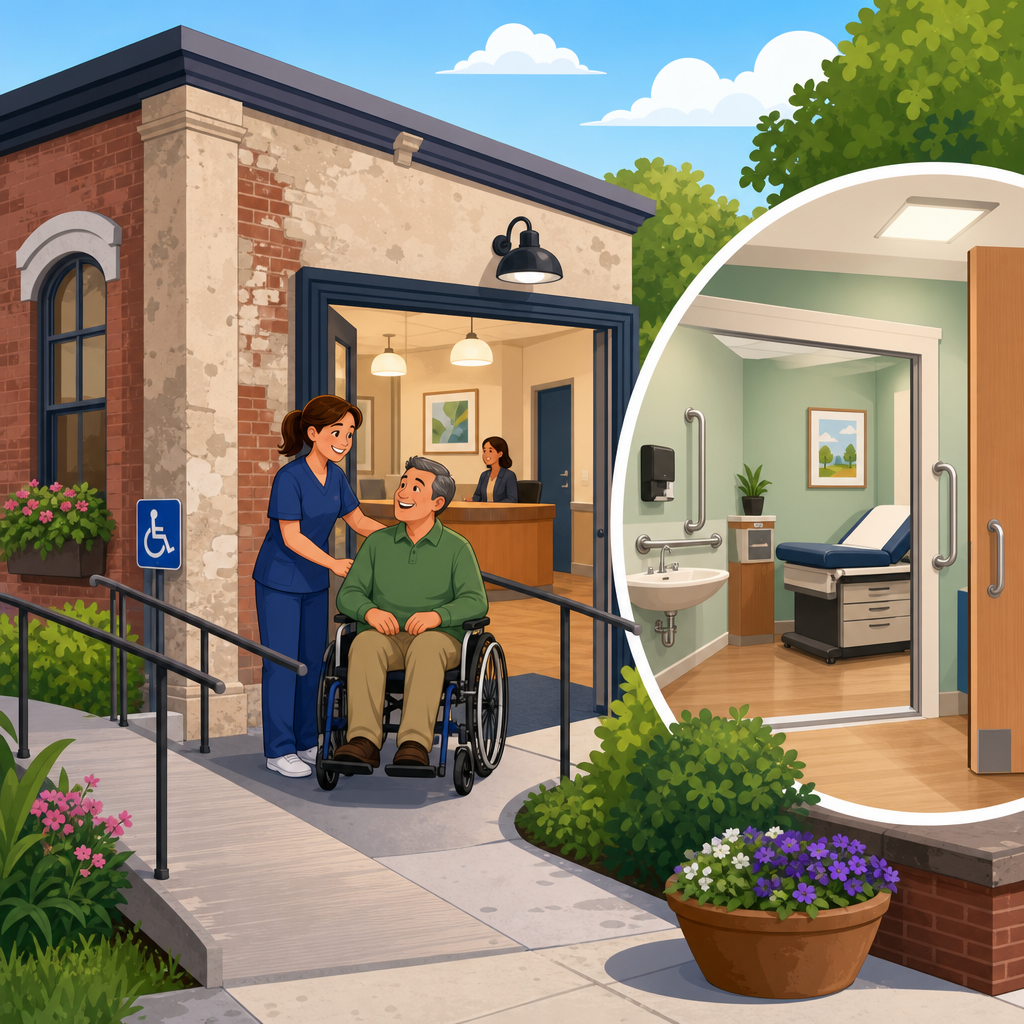
ADA compliance for medical offices with limited space and old buildings is one of the hardest accessibility challenges in healthcare, because patient care must continue while owners adapt structures that were never designed for modern mobility, communication, and safety standards. In healthcare, accessibility is not a design trend or a marketing point. It is a legal duty, a patient experience issue, and a clinical operations issue that affects scheduling, intake, exams, restroom access, emergency egress, and staff workflows every day. When I assess older clinics, the same pattern appears: narrow corridors, heavy doors, small waiting rooms, multi-level entries, undersized restrooms, and piecemeal renovations that solved one problem while creating another. The result is friction for patients using wheelchairs, walkers, canes, scooters, hearing devices, or visual aids, and risk for practice owners who assume age of the building excuses noncompliance.
The Americans with Disabilities Act sets the baseline. For medical offices, that usually means applying Title III requirements for places of public accommodation, along with the 2010 ADA Standards for Accessible Design. Facilities may also need to consider Section 504 if they receive federal financial assistance, state accessibility codes, the Fair Housing Act in mixed-use settings, and local building requirements triggered by alterations. Key terms matter. “Accessible route” means a continuous unobstructed path connecting site arrival points to entrances and interior spaces. “Barrier removal” refers to taking out obstacles when it is readily achievable, meaning easily accomplishable without much difficulty or expense. “Alteration” means a change affecting usability, which can trigger stricter obligations than routine maintenance. In healthcare, specialized exam equipment and effective communication obligations also matter, because access is not only about getting into the building. It is about receiving comparable care once inside.
This hub article explains how medical offices in older, smaller buildings can meet accessibility obligations in practical ways. It covers entrances, interiors, restrooms, exam rooms, communication, budgeting, and phased remediation. It also serves as a healthcare hub by framing the major issues that connect to deeper topics such as accessible parking, patient check-in, exam table selection, historic building constraints, and renovation planning. If you operate a primary care clinic, dental office, behavioral health practice, specialty suite, imaging center, or therapy office in a constrained footprint, the goal is not perfection on day one. The goal is to identify barriers, prioritize patient impact, document decisions, and make defensible improvements that reduce legal exposure while expanding access to care.
What ADA compliance means in healthcare settings
ADA compliance for medical offices is broader than standard retail accessibility because healthcare visits involve more physical transitions and more communication points. A patient may need accessible parking, a curb ramp, a door with enough clear width, space to maneuver at reception, an accessible restroom, an exam room with turning space, a height-adjustable exam table, a transfer lift, and auxiliary aids for hearing or vision. If any link in that chain fails, access to care is incomplete. In practice, I advise owners to evaluate the entire patient journey rather than isolated measurements. A front door that meets width requirements does not solve inaccessible intake counters or a mammography room with no transfer clearance.
The 2010 ADA Standards provide the technical dimensions many offices need, including door clearances, ramp slopes, turning circles, toilet room layouts, and signage rules. The Department of Justice has also made clear that healthcare providers must provide full and equal enjoyment of services. That expectation extends to policies and equipment, not only fixed architecture. For example, a practice cannot routinely examine wheelchair users in the waiting room because transferring to a standard table is difficult. The Office for Civil Rights within the Department of Health and Human Services has repeatedly emphasized accessible medical diagnostic equipment and effective communication, especially for patients who are deaf, hard of hearing, blind, or have low vision.
Challenges unique to small offices and older buildings
Limited space changes everything. In a new building, an architect can allocate turning radii, compliant toilet rooms, wider corridors, and proper door approaches from the start. In an older townhouse conversion or small suburban strip suite, every inch is already assigned. Radiators protrude into paths of travel, structural walls restrict restroom expansion, and mechanical systems occupy the only space where a lift might fit. Old buildings also carry hidden conditions such as uneven floors, noncompliant thresholds, lead paint, asbestos, and outdated electrical service that make simple modifications more expensive than they look on paper.
Historic character can add another layer. Exterior ramps, new entrances, or elevator additions may face preservation review. That does not erase accessibility obligations, but it may affect the method of compliance. In those cases, equivalent facilitation, alternate entrances, platform lifts where permitted, or carefully detailed route changes can become part of the solution. Healthcare operators in leased spaces face a different problem: landlords often control common areas, parking, and primary entrances, while tenants control interior build-outs and equipment. Lease language matters. I have seen practices discover too late that the lease assigned code upgrades to the tenant while the landlord retained approval rights over every alteration.
How to assess barriers and prioritize fixes
The most effective process starts with an access audit grounded in actual patient use. Measure parking stalls and access aisles, walk the route from sidewalk to reception, test door opening force, verify maneuvering clearances, review toilet room geometry, inspect signage, and assess exam room usability. Then compare findings against the 2010 standards, state code, and the office’s service model. A dermatology suite with procedure rooms has different equipment needs than a counseling practice, and a dialysis center has very different transfer risks than a pediatric office. Prioritization should focus first on barriers that prevent entry, block toilet access, or stop patients from receiving the core service.
| Priority level | Common barrier | Why it matters | Typical fix |
|---|---|---|---|
| High | Step-only entrance | Prevents basic entry | Ramp, lift, or accessible alternate entrance |
| High | Inaccessible restroom | Limits visit duration and dignity | Reconfigure fixtures, widen door, add grab bars |
| High | Fixed-height exam table only | Blocks equal clinical care | Install power exam table and transfer supports |
| Medium | Narrow interior doors | Restricts room access | Offset hinges, frame changes, door replacement |
| Medium | High reception counter | Impairs check-in communication | Provide lowered accessible transaction surface |
| Low | Signage gaps | Reduces wayfinding clarity | Add compliant tactile and visual signs |
Documentation is critical. Maintain drawings, field photos, measurements, cost estimates, landlord correspondence, and a written barrier removal plan. If a full restroom rebuild is not immediately feasible, document why, identify interim steps, and set a timeline tied to budgets or future alterations. This disciplined recordkeeping helps owners make rational capital decisions and demonstrates good-faith effort if a complaint arises.
Entrances, routes, and waiting areas in tight footprints
Most patient complaints begin before check-in. Accessible parking must connect to an accessible route without broken pavement, steep cross slopes, or missing curb ramps. At the entrance, common failures include hardware that requires tight grasping, thresholds above allowed height, vestibules too shallow for wheelchair maneuvering, and pull-side clearances blocked by planters, sanitizer stands, or chairs. In compact clinics, removing clutter is often the cheapest compliance improvement. I have seen a fully compliant route become unusable because brochure racks narrowed the clear width by six inches.
Waiting rooms should allow wheelchair users to sit with companions without blocking circulation. That means dispersed seating choices, not a token open spot next to the trash can. Reception should include an accessible counter or writing shelf at usable height, with enough knee and toe clearance if it serves as a transaction surface. Self-check-in kiosks, if used, must also be accessible. For many small practices, the better solution is keeping assisted check-in available rather than relying on a single touchscreen station that excludes part of the patient population.
Accessible restrooms and exam rooms
Restrooms are often the most difficult retrofit in old medical buildings because the original room was too small even before modern fixture clearances applied. Yet they are also one of the most consequential spaces for patient dignity and staff assistance. Common solutions include relocating a sink to create turning space, using an out-swing door, shifting partitions, selecting compact fixtures that still preserve required clearances, and reworking accessories such as dispensers, mirrors, and coat hooks. A single-user restroom can often be made workable with careful planning, but guessing is expensive. A few inches in the wrong location can invalidate the entire rebuild.
Exam rooms deserve equal attention. Healthcare accessibility is incomplete if patients can enter the suite but cannot be examined properly. At least some exam rooms should provide adequate maneuvering space, clear transfer sides, and accessible medical equipment. Height-adjustable exam tables are no longer optional best practice; they are central to equal care. The same is true for accessible weight scales where weight is clinically relevant. In specialty practices, accessible diagnostic equipment may include imaging supports, dental chairs with transfer space, or mammography configurations that accommodate seated positioning. Staff also need transfer training. Equipment alone does not create access if no one knows how to use it safely.
Communication access, policies, and staff training
Physical access is only one side of ADA compliance for healthcare. Medical offices must also ensure effective communication. That can include qualified sign language interpreters, video remote interpreting in appropriate circumstances, assistive listening systems, large-print forms, screen-reader-friendly patient portals, and clear procedures for communicating test results to patients with sensory disabilities. A common mistake is relying on family members to interpret complex medical information. That creates accuracy, privacy, and consent problems. Providers should have a defined process for arranging interpreters and documenting when and how communication needs were met.
Policies matter because many barriers are operational, not architectural. Examples include refusing to move a portable chair that blocks a route, scheduling all mobility-impaired patients in one distant room because it is “easier,” or requiring online forms that are not accessible. Front-desk and clinical staff should know how to greet patients respectfully, ask about accommodation needs, protect service animal access, operate accessible equipment, and escalate problems quickly. Training should be specific to the office layout and specialties. Generic annual slides are not enough. In my experience, ten minutes of room-by-room walk-through training prevents more access failures than a long policy memo no one reads.
Budgeting, phasing, and working with landlords and contractors
Few small practices can close for a full accessibility overhaul, so phasing is usually the right approach. Start with low-cost, high-impact fixes: adjust door closers, remove protruding objects, restripe parking, add signage, lower paper towel dispensers, install lever hardware, and purchase portable communication aids. Next, plan moderate projects such as counter modifications, door widening, and exam equipment replacement. Larger capital items, including restroom reconstruction, ramp installation, and elevator or lift work, often align best with lease renewals, larger renovations, or financing cycles.
Use qualified professionals. Accessibility surveys should be done by architects, certified access specialists where available, or contractors with demonstrated ADA healthcare experience. Medical workflows create constraints that ordinary commercial remodelers may miss. Infection control, privacy, radiology shielding, oxygen storage, and life safety requirements can intersect with accessibility decisions in ways that affect design details. For tenants, coordination with landlords should begin early and in writing. Clarify who pays for parking, entry, and common-area upgrades; who submits permits; how historic review or zoning issues will be handled; and how construction will occur without interrupting care. A realistic phased plan usually beats an aspirational master plan that never leaves the shelf.
Medical offices in limited-space, older buildings can achieve meaningful ADA compliance, but success depends on approaching accessibility as a healthcare operations issue, not just a construction checklist. The central lesson is simple: evaluate the full patient journey, fix the barriers that stop care first, and match every architectural decision with equipment, policy, and staff training. Small sites and historic constraints are real, yet they rarely eliminate the duty to improve access. They change the strategy. Readily achievable barrier removal, thoughtful alterations, accessible exam equipment, effective communication, and documented planning together create a defensible and patient-centered program.
As the healthcare hub within industry-specific guidance, this topic connects directly to deeper articles on parking, restrooms, check-in areas, exam tables, leased clinics, and preservation-sensitive retrofits. If you manage a physician office, dental suite, therapy practice, or specialty clinic, begin with an accessibility audit and a written remediation roadmap. That first step turns compliance from a vague legal worry into a concrete plan that expands access, reduces risk, and improves care for every patient who comes through your door.
Frequently Asked Questions
How can a medical office in a small or older building become ADA compliant without shutting down patient care?
Yes, in many cases a medical office can make meaningful ADA improvements without a full shutdown, but it takes careful planning. The first step is to assess how patients actually move through the practice, from parking and entry to check-in, waiting, exams, restrooms, and checkout. In older and space-constrained offices, the biggest barriers are often narrow doorways, tight turning spaces, steps at entrances, inaccessible restrooms, and exam rooms that do not allow safe transfers or wheelchair positioning. A formal accessibility review helps identify which obstacles create the greatest risk for patients and the greatest legal exposure for the practice.
Once those barriers are identified, the office can prioritize changes in phases. That may mean starting with the most essential access points, such as the primary entrance, reception desk approach, accessible route to treatment areas, and at least one accessible restroom if feasible. Scheduling construction during evenings, weekends, or slower clinic hours can reduce disruption. In some situations, practices temporarily repurpose rooms, adjust patient flow, or relocate certain services during renovation periods. The goal is not just to keep the office open, but to maintain safe and dignified care throughout the transition.
It is also important to remember that ADA compliance in healthcare goes beyond basic building access. Medical offices must think about whether patients with mobility limitations can actually receive services in an equivalent way. If a patient can enter the office but cannot get onto an exam table, use a restroom, communicate with staff, or access intake processes, the patient experience is still not fully accessible. For that reason, operational changes such as staff training, revised appointment procedures, portable equipment, and communication accommodations often work alongside physical upgrades. In older buildings, a phased strategy that combines construction and operations is often the most realistic path forward.
What ADA requirements matter most for medical offices operating in old buildings with limited square footage?
For medical offices in older buildings, the most important ADA issues are the ones that directly affect a patient’s ability to receive care safely and independently. That usually starts with the accessible route into the building and through the office. Patients need a usable path from parking or drop-off to the entrance, and then through reception, waiting, exam, and restroom areas as appropriate. In tight floor plans, even small obstructions such as furniture placement, file storage, decorative items, or poorly positioned equipment can create major barriers for wheelchair users, patients with walkers, and individuals with balance limitations.
Reception and intake areas are another high-priority concern. Patients must be able to approach the front desk, communicate with staff, and complete forms or alternative intake processes. In older practices, counters may be too high, circulation paths may be too narrow, and clipboard-based paperwork may not work well for patients with dexterity, vision, or cognitive limitations. Accessible communication can include lower transaction surfaces, digital forms, staff assistance protocols, large-print materials, and procedures for patients who are deaf or hard of hearing. Healthcare accessibility is not limited to construction standards; communication access is equally important.
Exam rooms are often where the biggest compliance and patient care issues appear. A medical office may technically allow entry, but if the room layout prevents wheelchair turning, side transfers, or caregiver assistance, the patient still faces unequal access. In many older buildings, not every exam room can be made identical, but practices should evaluate whether enough rooms are accessible for the services offered and whether accessible medical equipment is available. Restrooms are also a critical issue, especially if patients are expected to remain onsite for extended visits, testing, or treatment. Even when space is limited, medical offices should review what modifications are readily achievable and what alternative measures may be needed while longer-term solutions are planned.
Does being in a historic or very old building excuse a medical office from ADA compliance?
No, occupying a historic or older building does not automatically excuse a medical office from ADA responsibilities. Age of the structure may affect what modifications are practical, how they are implemented, and whether certain preservation rules apply, but it does not remove the obligation to provide accessible care. In healthcare settings, that distinction matters a great deal. Patients are not visiting a retail space for convenience; they are seeking medical services that can affect diagnosis, treatment, and safety. Because of that, accessibility problems in medical offices often carry both legal and clinical consequences.
Older buildings may present genuine structural limits. For example, load-bearing walls, stair-dependent layouts, plumbing restrictions, or very narrow footprints can make some changes more difficult or expensive. Historic preservation requirements can further complicate entrances, exterior ramps, or facade alterations. Even so, the office is still expected to evaluate what barriers can be removed, what modifications are feasible, and what equivalent access methods can be provided. In many cases, accessibility can be improved through a mix of targeted renovations, equipment upgrades, room reassignment, and operational accommodations rather than a single major rebuild.
The key point is that “old building” is not a complete defense. Practices should document accessibility assessments, improvement plans, and any constraints that genuinely limit certain changes. They should also avoid relying on assumptions. What seems impossible at first may have a workable solution when reviewed by ADA-focused designers, contractors, or legal advisors familiar with healthcare environments. A thoughtful, documented effort to improve access is far better than doing nothing and hoping the building’s age will justify the barriers. For medical offices, the expectation is to make accessibility a real operational priority, not merely a theoretical one.
What if a medical office does not have enough room for fully accessible exam rooms or restrooms?
Limited space is one of the most common and difficult problems in older medical offices, but lack of square footage does not eliminate the need to improve access. The right response begins with an honest review of how services are delivered and which spaces create the biggest obstacles. If not every room can be made fully accessible, the office should determine whether specific rooms can be reconfigured to serve as accessible exam rooms, whether furniture and fixed equipment can be reduced, and whether patient flow can be changed to make the best use of the most functional spaces. Sometimes a single well-planned room can significantly improve access if it is consistently available for patients who need it.
For exam areas, practices should consider more than room size alone. Accessible care also depends on equipment, staff support, and transfer safety. Height-adjustable exam tables, accessible weight scales, transfer aids, and staff training may help bridge some physical constraints. In a small office, it may also make sense to schedule patients who need the most accessible room into specific time blocks so that the space is available without delay. These operational adjustments are not substitutes for all physical modifications, but they can be essential parts of a practical compliance strategy.
Restrooms are often harder because plumbing locations and wall configurations can severely restrict what is possible. If a restroom cannot be fully reworked immediately, the practice should still evaluate whether partial improvements can reduce barriers, such as door hardware changes, grab bars where appropriate, fixture repositioning, clearer maneuvering space, or better route access. The office also needs to think carefully about patient dignity and visit length. If patients are onsite for procedures, waiting periods, or mobility-intensive appointments, restroom access becomes more urgent. In some cases, the long-term answer may involve a larger renovation, suite reconfiguration, or relocation. What matters most is that the practice has a real plan, not an indefinite delay.
Why is ADA compliance in a medical office more than just avoiding lawsuits?
ADA compliance in healthcare is often discussed in legal terms, but for medical offices it is just as much about patient safety, care quality, and operational reliability. When patients cannot enter the building easily, reach the reception desk, transfer to an exam surface, use the restroom, or understand communication from staff, the result is not just inconvenience. It can lead to delayed care, incomplete exams, inaccurate assessments, canceled appointments, unsafe transfers, and a loss of trust in the practice. Accessibility failures directly affect how medicine is delivered.
There is also an important workflow dimension. Offices that lack accessible space or equipment often end up improvising. Staff may spend extra time relocating patients, finding alternate rooms, physically assisting with transfers that should have been equipment-supported, or trying to solve communication problems in the moment. That creates inefficiency, raises injury risk for both patients and employees, and puts pressure on scheduling. By contrast, an office that plans for accessibility tends to operate more smoothly because patient needs are anticipated rather than treated as exceptions. In that sense, ADA compliance supports clinical operations as much as legal compliance.
Finally, accessibility is central to patient experience and reputation. Patients notice whether a practice makes them feel welcome, respected, and safe. In an era where healthcare choices are influenced by referrals, reviews, and community trust, inaccessible conditions can quietly damage a practice even before a formal complaint arises. More importantly, medical care should be equitable. A patient with mobility, sensory, or communication limitations should not receive a lower standard of access simply because the office is old or small. That is why ADA compliance should be treated as an ongoing part of healthcare delivery, budgeting, and risk management, not as a one-time box to check.