Technical Specifications, Geometric Standards, and Compliance Risk Management
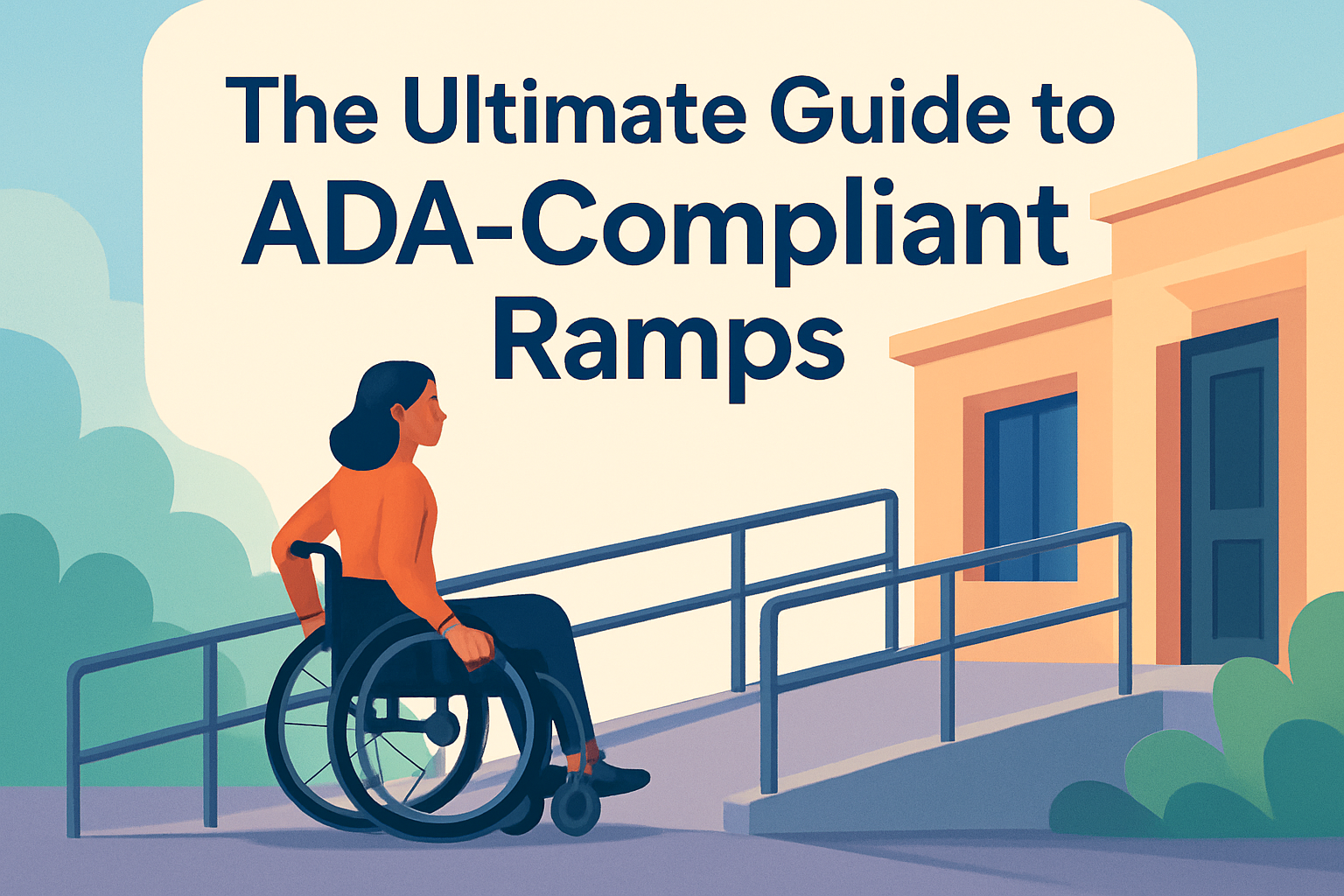
The construction and alteration of facilities serving the public must adhere strictly to the minimum accessibility requirements mandated by federal law. Among the most critical structural components ensuring access for individuals with mobility disabilities are accessible ramps. Compliance with the Americans with Disabilities Act (ADA) Standards for Accessible Design requires a meticulous understanding of specific technical specifications regarding slope, rise, geometry, and safety features.
This comprehensive technical guide serves as an authoritative reference for compliance professionals, architects, general contractors, and facility managers, detailing the enforceable standards set forth primarily in the 2010 ADA Standards, particularly Section 405 (Ramps) and Section 505 (Handrails).
Foundational Principles: Legal Mandate and Scoping Requirements
The Americans with Disabilities Act (ADA) Framework and the Accessible Route
The legal authority for accessible design rests within the Americans with Disabilities Act of 1990. The Department of Justice (DOJ) published revised regulations for Titles II and III of the ADA, adopting the 2010 ADA Standards for Accessible Design (2010 Standards). These Standards establish the enforceable minimum scoping (what elements must be accessible) and technical (how they must be constructed) requirements.1
State and local government facilities (Title II) and public accommodations and commercial facilities (Title III) must follow the 2010 Standards. Compliance with these revised standards was required for new construction and alterations starting on March 15, 2012.
The Role of the Accessible Route
Ramps are not isolated features; they are integral components of the accessible route. An accessible route is defined as a continuous, unobstructed path that connects all accessible elements and spaces within a building or facility. These routes encompass interior elements such as corridors, floors, ramps, elevators, and lifts, as well as exterior components, including parking access aisles, curb ramps, crosswalks at vehicular ways, and walks.
For any newly designed or constructed facility, or any altered facility, the accessible route must be readily accessible to and usable by individuals with disabilities. Furthermore, accessible entrances must be located on the shortest accessible route relative to site arrival points, such as accessible parking spaces, compared to other general parking spaces. This ensures that accessible design prioritizes user convenience and efficiency.
A key point of interpretation is that these federal regulations represent the minimum acceptable level of accessibility. Compliance professionals must recognize that the 2010 Standards establish a foundational floor, not a ceiling. Jurisdictions at the state or local level may impose stricter design requirements (known as GEO compliance), and facility owners must satisfy the most rigorous standard applicable to their location.
New Construction versus Alterations and Existing Facilities
The application of the 2010 Standards varies slightly depending on the project type: new construction or alteration of existing sites.
New Construction Mandates
Any facility or part of a facility constructed by, on behalf of, or for the use of a public entity (if construction commenced after January 26, 1992) must be designed and constructed to be readily accessible. In new construction, ramps must strictly adhere to the fundamental rule stipulating a maximum running slope not steeper than 1:12, without reliance on the special exceptions detailed for existing structures (ADA §405.2).
Alterations and Barrier Removal
The 2010 Standards provide the technical reference point for existing facilities undergoing alteration. For Title II public entities, the standards guide structural changes necessary to meet program accessibility requirements. For Title III public accommodations, the standards govern readily achievable barrier removal.
When retrofitting an existing building, achieving the 1:12 maximum slope may be impossible due to existing structural limitations. In such limited circumstances, the standards permit exceptions for steeper slopes; however, these exceptions are only permissible where the slopes are necessary due to space limitations.
Temporary and Portable Ramps
The necessity for accessibility extends beyond permanent structures to temporary buildings and facilities, such as reviewing stands, temporary classrooms, or safe pedestrian passageways around construction sites. Ramps intended for use by the general public at temporary events should comply with the standards for permanent ramps.
The use of portable ramps for barrier removal is strictly conditional. Portable ramps are only permitted to comply with barrier removal requirements when the installation of a permanent ramp is explicitly not readily achievable. The law recognizes the inherent safety issues and inconvenience associated with portable ramps. If portable ramps are used, due consideration must be given to safety features, including nonslip surfaces, adequate railings, secure anchoring, and appropriate material strength.
For facility managers, this means viewing a portable ramp as a measure of last resort, not a convenient substitute for permanent structural changes. Deploying a non-compliant portable ramp simply for convenience, or where a permanent compliant solution is structurally and financially feasible, constitutes an accessibility violation.
Interplay with Building Codes (IBC and ANSI A117.1)
Accessible design often requires coordination between federal accessibility standards (ADA) and broader life safety codes, such as the International Building Code (IBC). The IBC, which addresses overall occupant safety, contains scoping provisions for accessibility (identifying what and how many elements must be accessible) but often references ICC A117.1, Accessible and Usable Buildings and Facilities, for the technical specifications of how those elements are built. ANSI A117.1 is designed to maintain consistency with the federal ADA regulations.
A critical point of required coordination between the codes is the design of safety barriers, specifically Edge Protection (ADA) versus Guardrails (IBC). The ADA mandates edge protection (Section 405.9) to prevent wheelchair casters, crutch tips, or feet from slipping off the edge of a ramp or landing.10 This typically involves a low curb or barrier, generally 4 inches high.1
In contrast, the IBC requires guardrails where there is a vertical drop-off exceeding 30 inches. Guardrails are significantly taller structures, usually 42 inches high, designed to prevent standing adults from falling. A ramp system with a significant elevation (e.g., 32 inches above grade) triggers both requirements simultaneously: ADA 405.9 for low edge protection to ensure accessibility and IBC 1015 for a high guardrail to ensure life safety. Architects and contractors must design the safety system to fulfill both distinct functions, as satisfying one code in isolation leaves a catastrophic compliance gap.
The Mathematics of Accessibility: Running Slope, Rise, and Geometry (ADA §405.2 – §405.6)
The functional usability of a ramp is determined primarily by its precise geometry. Section 405 details the technical criteria for slope, width, and rise.
Calculating the Running Slope (405.2) and Cross Slope (405.3)
Running Slope
The most fundamental requirement of ramp design is the running slope, defined as the slope in the direction of travel (rise divided by run). Ramp runs must have a running slope not steeper than 1:12. Expressed as a percentage, this ratio limits the maximum incline to 8.33 percent.
The 1:12 ratio dictates the necessary horizontal length (run) for a given vertical elevation change (rise). For example, a facility entrance with a total rise of 30 inches necessitates a minimum horizontal run of 360 inches (30 \text{ inches } \times 12 \text{ ratio} = 360 \text{ inches}), translating to a minimum ramp length of 30 feet. Achieving the shallowest possible slope is consistently recommended to accommodate the widest range of users, particularly those with limited stamina or cardiovascular conditions.
Cross Slope
Equally important, yet frequently overlooked in construction, is the cross slope. The cross slope is the slope measured perpendicular to the direction of travel. Cross slope of ramp runs must not be steeper than 1:48. This equates to a maximum slope of 2.08 percent.
The meticulous adherence to the 1:48 cross slope maximum is essential for user stability. If the cross slope is too steep, it can cause a manual wheelchair to drift laterally, requiring significant effort from the user to maintain a straight path, potentially leading to tipping or injury. Furthermore, maintaining a slope no steeper than 1:48 ensures adequate drainage while preventing the accumulation of water on the ramp surface, which would otherwise compromise the required floor or ground surfaces compliance (Section 302 related to stability and slip resistance). Excessive cross slope is one of the most common construction defects cited in compliance audits.
Critical Exceptions for Existing Structures (Table 405.2 Analysis)
While the 1:12 slope is the mandatory standard for new construction, the ADA provides limited exceptions for existing sites, buildings, and facilities undergoing alteration, specifically where space limitations make full 1:12 compliance structurally infeasible.
These exceptions are strictly tied to a maximum allowable rise per ramp run:
Table A: Maximum Ramp Slope and Rise for Existing Sites, Buildings, and Facilities (ADA Table 405.2)
| Slope Ratio | Slope Percentage Range | Maximum Rise Allowed | Prohibition |
| Steeper than 1:12 but not steeper than 1:10 | 8.33% to 10% | 6 inches (150 mm) | A slope steeper than 1:8 is prohibited |
| Steeper than 1:10 but not steeper than 1:8 | $10% to 12.5% | 3 inches (75 mm) | A slope steeper than 1:8 is prohibited |
These exceptions permit a slightly steeper slope only for overcoming small changes in elevation when space is severely constrained.The slope is capped at 1:8 (or 12.5 percent) for the smallest rise (3 inches).
However, professionals must exercise caution regarding these exceptions, particularly when dealing with geographic compliance requirements. Some jurisdictions, such as California, impose stricter local building codes (e.g., the California Building Code, CBC) that may be more stringent than the federal ADA minimums. The CBC specifically omits the exception detailed in Table 405.2, meaning that in such jurisdictions, the 1:12 maximum slope must be adhered to universally, even in existing facilities undergoing alterations. In these cases, the local code overrides the federal exception, demonstrating the paramount importance of checking state and local standards before design finalization.
Maximum Rise, Clear Width, and Surface Requirements (405.6, 405.5, 405.4)
Three additional geometric requirements govern the design of the ramp path itself:
Maximum Rise Per Run
The vertical rise for any single ramp run is limited to a maximum of 30 inches (760 mm). If the total elevation change exceeds 30 inches, the ramp system must be segmented by intermediate level landings to provide resting points.
Minimum Clear Width
The minimum clear width of a ramp run must be 36 inches (915 mm). If handrails are provided, the 36-inch clear width must be measured between the handrails. Handrails, posts, or other fixtures must not project into this required 36-inch maneuvering space.
Floor or Ground Surfaces
The surfaces of the ramp run must be stable, firm, and slip-resistant in compliance with Section 302 of the Standards. This ensures traction and maneuverability regardless of whether the surface is interior or exterior. Landings must also meet these surface requirements.
Table B: Core Technical Specifications for Ramp Runs and Landings (ADA §405 Summary)
| Criterion | Federal Requirement (New Construction) | Ratio/Percentage Equivalent |
| Maximum Running Slope | Not steeper than 1:12 | $8.33\%$ maximum |
| Maximum Cross Slope | Not steeper than 1:48 | $2.08\%$ maximum |
| Maximum Rise per Run | 30 inches (760 mm) | Mandatory landing separation if exceeded |
| Minimum Clear Width | 36 inches (915 mm) | Measured between handrails if provided |
| Minimum Landing Slope | Not steeper than 1:48 | 2.08% maximum |
Landing Requirements: Rest, Maneuvering, and Doorway Integration (ADA §405.7)
Ramp landings are critical level transition and resting areas, often representing a primary source of construction non-compliance due to inadequate sizing or slope deviation. Landings are required at the top and bottom of every ramp run.
Essential Landing Geometry and Slope
Landing Slope
Ramp landings are required to have a slope not steeper than 1:48 in any direction. This strict limit prevents the landing area, which is intended for resting and maneuvering, from inadvertently adding to the effort required to use the ramp. Furthermore, landings must be designed to prevent the accumulation of water.
Minimum Dimensions
The required minimum dimensions for landings ensure adequate space for mobility device users to rest and prepare for the next ramp segment or transition to the accessible route:
- Width (405.7.2): The clear width of the landing must be at least as wide as the widest ramp run feeding into it. Given the minimum ramp width of 36 inches, the landing width must be at least 36 inches.
- Length (405.7.3): The clear length of the landing must be a minimum of 60 inches (1525 mm).
Maneuvering Clearance at Direction Changes
For ramp systems that change direction between runs—such as switchback or dogleg configurations—the landing must provide adequate space for turning. This turning space must be a minimum clear area of 60 inches (1525 mm) by 60 inches (1525 mm).
The 60” times 60” clearance is specifically designed to accommodate the turning radius of a typical wheelchair, ensuring a user can navigate the change in direction safely and efficiently. It is imperative that this maneuvering space remain completely clear; handrails, vertical posts, or edge protection elements must not obstruct or overlap the minimum 60” times 60” clearance area. A common design fault is providing a landing that is merely the ramp width (36 inches) by the minimum length (60 inches), which is insufficient for a directional change.
Integrating Doorways and Overlapping Clearances (405.7.5)
A crucial exception for space efficiency arises when a doorway is located immediately adjacent to a ramp landing. Section 405.7.5 permits the required maneuvering clearances for the door to overlap the required landing area.
Standard accessible doorways require specific maneuvering clearances (governed by ADA Section 404, specifically 404.2.4 and 404.3.2) to allow a user to approach, open, and pass through the door using a mobility device. These clearances can range significantly, requiring clearances of 48 to 60 inches depending on the direction of approach (front versus hinge side) and operation (push versus pull).
The overlapping provision is necessary because, without it, a landing serving a doorway requiring a 60-inch pull-side clearance would need the standard 60-inch landing length plus the 60-inch door clearance, demanding 10 feet of clear space in the direction of travel. By permitting the overlap, the 60-inch landing area can simultaneously function as the necessary door maneuvering space, provided the landing is designed to incorporate the specific dimensional needs of the adjacent door clearance.1
A specific condition applies to doorways subject to locking: if the door adjacent to the landing can be locked, the landing must be sized to incorporate the full turning space required by Section 304.3, typically ensuring a 60” times 60” minimum clear area, to allow a wheelchair user to turn and reverse their direction if they are unable to open the door.
Safety and Protection Features: Handrails and Edge Barriers (ADA §405.8 – §405.10)
Safety mechanisms such as handrails and edge protection are essential to prevent falls, loss of control, and accidental roll-offs.
Handrail Scoping and Requirement (405.8)
Handrails are required on both sides of a ramp run if the rise exceeds 6 inches (150 mm), or if the horizontal projection of the run is greater than 72 inches.
If mandated, these handrails must comply with the stringent technical criteria detailed in Section 505 of the Standards. An exception exists within employee work areas where handrails are not required if the ramp paths are designed to permit the installation of Section 505-compliant handrails at a later date, should the need arise.
Detailed Handrail Specifications (ADA §505)
Handrail design is precisely regulated to ensure maximum usability and safety for a variety of hand sizes and gripping capabilities.
Height and Continuity
The top of the gripping surface of the handrail must be maintained at a consistent height, measuring between 34 inches (865 mm) minimum and 38 inches (965 mm) maximum vertically above the ramp surface. Handrails must be continuous throughout the entire length of the ramp run. In switchback or dogleg ramps, the inside handrails must be continuous between runs to maintain support during the transition.
For facilities where children are the principal users (such as elementary schools), a second, lower set of handrails is highly recommended to aid younger users and reduce accident risk.25 This secondary handrail should have a maximum height of 28 inches (710 mm) from the ramp surface, with a vertical clearance of 9 inches (230 mm) minimum maintained between the upper and lower handrails to prevent entrapment hazards.
Grip and Clearance
The cross-section of the gripping surface is strictly controlled to ensure a power grip can be maintained:
- Circular Cross Section (505.7.2): Handrails with a circular cross section must have an outside diameter of 1 1/4 inches (32 mm) minimum and 2 inches (51 mm) maximum.
- Clearance (505.5): The clearance between the handrail gripping surface and any adjacent surface (such as a wall) must be 1 1/2 inches (38 mm) minimum. This dimension is critical for preventing knuckles from scraping against the wall while ensuring sufficient space for users with limited dexterity.
- Obstruction: The gripping surfaces must be continuous and unobstructed along their tops and sides. The bottom surface must not be obstructed for more than 20 percent of its length.
Extensions
At both the top and the bottom of the ramp run, handrails must extend horizontally a minimum of 12 inches beyond the ramp run in the direction of travel. This extension allows users to establish stability before ascending or to slow their descent after reaching the landing.
Table C: Handrail Technical Dimensions (ADA §505)
| Criterion | Federal Requirement | Minimum/Maximum |
| Height of Gripping Surface | 34 inches to 38 inches | 865 mm minimum / 965 mm maximum |
| Minimum Clearance from Wall | 1 1/2 inches (38 mm) minimum | Required for full length |
| Grip Diameter (Circular) | 1 1/4 inches to 2 inches | 32 mm minimum / 51 mm maximum |
| Horizontal Extensions | 12 inches (305 mm) minimum | Required at top and bottom of run |
Edge Protection Requirements (405.9)
Edge protection is a vital accessibility feature designed to prevent wheelchairs, scooters, or crutch tips from slipping off the sides of the ramp where a drop-off exists.10 Edge protection is required on both sides of ramp runs and ramp landings.
Compliance with Section 405.9 can be achieved through two primary methods:
- Curbs or Barriers (405.9.1/2): A low curb must be provided, measuring at least 4 inches high. Alternatively, a rail or barrier must be installed that prevents the passage of a 4-inch diameter sphere between the surface and the barrier.
- Extended Ramp Surface: Edge protection is also deemed compliant if the surface of the ramp run or landing extends horizontally at least 12 inches (305 mm) beyond the inside face of the handrails. This design method provides a buffer zone, preventing mobility devices from approaching the edge where the vertical drop occurs.
For sites utilizing the 4-inch curb option, it is essential to coordinate this feature with the broader IBC guardrail requirements. If the adjacent drop-off exceeds 30 inches, a 42-inch guardrail must be incorporated for life safety (IBC), in addition to the low 4-inch barrier required for accessibility (ADA).
Exceptions to Edge Protection (405.9 Exceptions)
There are three specific scenarios where the requirement for edge protection is waived :
- Ramps that are not required to have handrails (i.e., runs with a rise of 6 inches or less) are exempt, provided the sides comply with the requirements for curb ramp flares (Section 406.3).
- Edge protection is not required on the sides of ramp landings that serve an adjoining ramp run or stairway, as these surfaces provide protection.
- Edge protection is not required on the sides of ramp landings having a minimal vertical drop-off of 1/2 inch (13 mm) maximum, provided this minimal drop occurs within 10 inches (255 mm) horizontally of the minimum required landing area. This allowance acknowledges the difficulty of maintaining a perfectly flush transition and provides a practical tolerance for grading and construction.
Specialized Ramp Types and Jurisdictional Compliance
While the core principles of slope and width apply broadly, specific ramp types, particularly those in the public right-of-way, introduce unique criteria, and local codes frequently exceed federal minimums.
Curb Ramps and Public Rights-of-Way (PROWAG Context)
Curb ramps are necessary elements connecting pedestrian walking surfaces to vehicular ways, ensuring accessibility across curb lines. Although governed by the same running slope and cross slope rules as standard building ramps, curb ramps have unique geometric considerations.
Measurement and Flared Sides
The required 36-inch minimum clear width for the ramp run must be measured precisely, excluding any flared sides. Curb ramps frequently use flared sides to transition from the street level back up to the sidewalk surface. If pedestrians must occasionally traverse these flared sides, the flares themselves are regulated.
Slope Control and Detectable Warnings
The cross slope of the ramp run may not exceed 2 percent. Furthermore, the slope of the gutter area bordering the curb ramp is regulated, often restricted to a maximum of percent towards the curb ramp, to ensure stability at the street transition point.
A critical feature often mandated by Public Rights-of-Way Accessibility Guidelines (PROWAG), which aligns with the ADA and is cited in state-level compliance guides (e.g., Minnesota and Oregon), is the presence of detectable warnings. These typically involve truncated domes placed at the bottom of the curb ramp to alert individuals who are blind or have low vision to the transition into a vehicular path. The failure to install or maintain appropriate detectable warnings is a common and serious omission in curb ramp construction.
The Stricter Standards: Navigating State and Local Code Variations
Compliance with the ADA is inherently a requirement to adhere to the most rigorous applicable standard. In many jurisdictions, state or local building codes supersede the federal ADA minimums by imposing tighter restrictions.
As previously noted, the California Building Code (CBC) eliminates the federal exception for steeper slopes in existing facilities, effectively mandating as the maximum slope for all accessible ramps built or altered within the state. This simplifies the rule but makes compliance more difficult for existing structures with limited space.
Similarly, regional transportation authorities may adopt stricter internal standards. For instance, the Oregon Department of Transportation (ODOT) may mandate a percent maximum ramp running slope in certain contexts, which is tighter than the percent federal maximum. Furthermore, local authorities may dictate specific measurement methodologies designed to ensure stricter tolerances. The City of Portland, Oregon, for example, specifies the use of a 2-foot level instead of a standard 4-foot level for measuring maximum grades on ramps and landings. This approach better captures localized imperfections in construction, holding contractors to a higher standard of finish quality.
For any project, the architect or contractor must cross-reference the federal 2010 Standards (the floor) with the locally enforced building codes (the ceiling), defaulting to the dimension or tolerance that provides the highest degree of safety and accessibility.
VI. Audit, Maintenance, and Avoiding Catastrophic Violations
Rigorous adherence to technical specifications is not simply a legal formality; it is a fundamental exercise in professional risk management. Failures in ramp compliance often stem from misinterpreting guidelines, insufficient planning, or construction error.
Top 5 Most Common ADA Ramp Design and Construction Violations
Analysis of accessibility litigation and compliance checklists reveals recurring design and construction defects that result in non-compliant ramps:
- Excessive Cross Slope: Failure to maintain the maximum cross slope. This often occurs when integrating the ramp into uneven existing topography or when pooling water is not adequately addressed during concrete pouring.
- Inadequate Landing Dimensions or Slope: Landings that are too short (less than 60 inches) or fail to provide the times turning radius required at direction changes. Landings may also frequently exceed the maximum slope, negating their function as a level rest area.
- Missing or Non-Compliant Handrails: Omitting handrails entirely where the rise exceeds 6 inches, or failing to include the required 12-inch horizontal extensions at the top and bottom of the run.
- Insufficient Clear Width: Allowing structural elements, support posts, or improperly installed handrails to project into the required 36-inch minimum clear path.
- Lack of Edge Protection: Failing to install the 4-inch minimum curb or barrier, or failing to extend the ramp surface 12 inches beyond the handrail, resulting in an immediate drop-off hazard.
Compliance Inspection Protocols and Measurement Methods
The complexity of ramp standards necessitates formal inspection and auditing processes. The use of standardized checklists, such as those employed by state agencies like MnDOT or ODOT, is crucial for consistency in field data collection.30 These inspection protocols formalize the measurement methods used to verify compliance.
It is strongly recommended that compliance is confirmed by a specialized, certified professional, such as a Certified Access Specialist (CASp, typically in California), who can identify potential violations preemptively.18 The purpose of these audits is to prevent systemic construction errors. When construction deviations push the measured slopes just past the tolerance thresholds (e.g., running slope or cross slope), costly rework or complete retrofitting is mandated.
The Financial and Legal Consequences of Non-Compliance
For architects, contractors, and facility owners, non-compliance carries severe professional and financial risks.
When a facility is determined to be non-compliant, the responsible entity is typically required to undertake structural modification (retrofitting) to bring the ramp into compliance.33 The cost of retrofitting structural elements, particularly poured concrete ramps, can be exponentially higher than the initial cost of compliant design and construction.
Furthermore, non-compliance exposes the property owner and potentially the design/build team to legal action under the ADA and related state civil rights laws. In jurisdictions with explicit statutory damages, such as California’s Unruh Civil Rights Act, violations can result in substantial monetary penalties—potentially $4,000 per violation—in addition to court costs and legal fees.
Rigorous quality control and adherence to precise technical guidelines, coupled with expert pre-inspection consultation, transform accessibility compliance from a legal mandate into an essential component of prudent professional risk management. The investment required for meticulous measurement of running slopes, the cross slope, and the mandatory 60-inch landings is negligible compared to the financial liability associated with litigation and corrective construction.
Frequently Asked Questions
1. What are the key technical specifications for an ADA-compliant ramp?
When designing an ADA-compliant ramp, several critical technical specifications must be adhered to for proper compliance. Firstly, the slope of the ramp is one of the essential technical aspects to consider. The maximum slope for a wheelchair ramp should be 1:12, meaning for every inch of vertical rise, there should be at least 12 inches or one foot of ramp run. This ensures the ramp is not too steep and is accessible for individuals using wheelchairs or those with mobility impairments. Another crucial specification is the width of the ramp. An ADA-compliant ramp should have a clear width of at least 36 inches, excluding the handrails. This ensures enough room for wheelchairs to pass easily. It’s also important that ramps include a level landing at the top and bottom of each ramp run. Landings must be at least as wide as the ramp and have a minimum length of 60 inches, which provides a proper turning space for wheelchair users. In addition, ramps must have edge protection to prevent wheelchairs or other devices from slipping off. This can be achieved by ensuring the sides of the ramp have curbs, walls, or railings. Handrails are another vital component; they are required on both sides of the ramp if the rise of the ramp is greater than 6 inches. These handrails must be between 34 and 38 inches high for proper accessibility.
2. What are the geometric standards for constructing ADA-compliant ramps?
The geometric standards for ADA-compliant ramps focus on ensuring usability and safety for individuals with disabilities. Starting with the landing size, every ramp needs a flat landing at the top and bottom for safety and accessibility. Landings should always be at least 60 inches in length to provide enough space for wheelchairs to rest, turn, or change direction safely. Furthermore, ramps must not have any vertical level changes that may pose tripping hazards or impede wheelchair movement. Any change in level greater than 1/4 inch should be beveled, and anything over 1/2 inch requires a ramp or some type of elevation change mechanism to transition smoothly. The cross slope, or the slope perpendicular to the direction of travel on the ramp, should not exceed 1:48. This small slope ensures water doesn’t pool on the ramp, which can cause slipping hazards, while still maintaining ease of navigation for wheelchairs. An essential aspect to consider is the length of the ramp runs. When ramps have rise greater than 30 inches, they will require an intermediate landing. These design considerations ensure that the ramps do not exhaust or impede individuals who require more time and energy to navigate ramps.
3. Why is compliance risk management critical in ramp design?
Compliance risk management plays an indispensable role in ramp design, ensuring that organizations avoid potential legal repercussions while fostering an inclusive environment. Non-compliance with ADA Standards can lead not only to legal fines and penalties but also to damage to an organization’s reputation, which can be far costlier in the long run. Risk management ensures that from the planning stage through to construction and use, the ramp meets or exceeds all necessary requirements. This process involves meticulous documentation, employing qualified professionals who understand ADA requirements, and conducting regular audits to ensure any changes in standards are followed. Moreover, considering liability risks, if someone were to get injured due to poorly designed or maintained ramps, the organization could face significant litigation costs. Thus, consistent risk management practices help mitigate these potential risks by ensuring safety and compliance are top priorities, thus benefiting both the organization and the community they serve.
4. How do handrails contribute to ADA-compliant ramp designs?
Handrails are a critical component in ADA-compliant ramp designs as they provide support and stability to users, particularly those with mobility challenges. The primary function of handrails is to offer something that individuals can grasp for balance and to propel themselves, which is especially important for the elderly and those with decreased muscle strength. Per ADA guidelines, handrails need to be installed on both sides of the ramp when the rise is greater than 6 inches. They must be continuous along the entire length of the ramp run, including at landings and must extend 12 inches beyond the top and bottom of the ramp. This extension aids in transitioning from walking to ramp use more smoothly. The height of these handrails should be between 34 to 38 inches from the ramp surface. They should also provide a clearance space of at least 1.5 inches between the handrail and any wall or obstruction, ensuring users can easily grip the railing without impediments. Additionally, the handrail surface must be smooth to prevent injury and should not rotate within their fittings. Ends of handrails should be rounded or returned smoothly into walls to prevent clothing snags and injuries. These precise details help build an accessible environment that anticipates the varied needs of all users.
5. What maintenance considerations are necessary for ADA-compliant ramps?
Maintaining an ADA-compliant ramp is just as crucial as its design and construction to ensure ongoing safety and accessibility. Regular inspections should be conducted to check for any wear and tear that could affect structural integrity or safety. Ramps should be kept clear of any debris, snow, or ice which can create hazardous conditions, especially for individuals with mobility impairments. Pay particular attention to the traction on the ramp surface. Ensure that the surface remains slip-resistant under various weather conditions, and reapply or enhance any traction materials as needed. Also, verify the condition of the handrails, ensuring they remain secure, smooth, and free of rust or damage. Additionally, environmental factors such as rain or temperature changes can affect how a ramp wears over time. Therefore, scheduled evaluations should include checking for any water damage, warping, or expansion problems that might require repair or replacement. Ultimately, efficient maintenance practices not only prevent accidents and potential liability but also reflect a commitment to providing an inclusive and accessible facility. Implementing a structured maintenance schedule ensures that ramps remain safe and compliant, reaffirming access for all users.