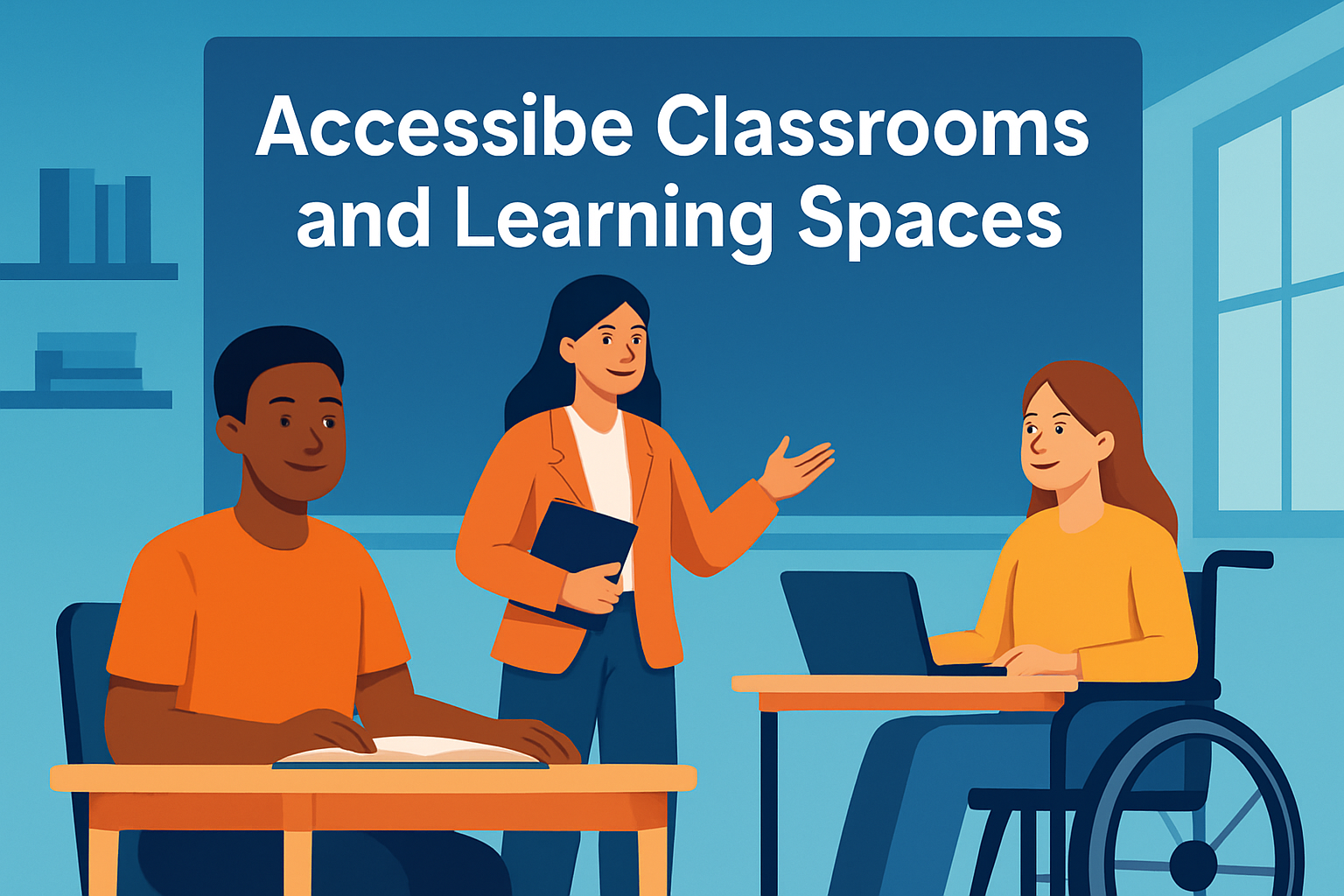
Accessible classrooms and learning spaces are environments designed so every learner can participate, move, communicate, and succeed without unnecessary barriers. In practice, that means far more than adding a ramp or reserving a front-row seat. It includes physical design, sensory conditions, digital access, teaching methods, furniture, acoustics, signage, and the policies that shape daily classroom use. I have worked with schools reviewing room layouts, assistive technology plans, and lesson delivery, and the same pattern appears repeatedly: when accessibility is planned from the start, all students benefit, not only those with documented disabilities.
The term accessibility refers to the extent to which a space, tool, service, or experience can be used by people with a wide range of abilities. In education, accessibility intersects with inclusive design, Universal Design for Learning, and legal compliance. In the United States, schools often work within the Americans with Disabilities Act, Section 504 of the Rehabilitation Act, and the Individuals with Disabilities Education Act. In the United Kingdom, the Equality Act 2010 and related guidance shape comparable responsibilities. The legal frameworks differ by country, but the principle is consistent: students must have equitable access to learning.
This matters because barriers in learning spaces are cumulative. A student using a wheelchair may face a narrow doorway, fixed desks, and a science bench that is too high. A student with low vision may struggle with dim lighting, poor contrast on projected slides, and inaccessible digital handouts. A student with autism may find fluorescent flicker, unpredictable noise, and visual clutter exhausting before the lesson even begins. Educators often focus on curriculum first, yet the environment itself can determine whether teaching is usable. Accessible classrooms reduce friction, improve independence, support attendance, and create conditions where academic expectations can remain high because participation is realistic.
Schools also gain practical advantages. Well-designed rooms are easier to schedule, more flexible for different teaching formats, and less dependent on one-off accommodations. They support compliance, reduce avoidable complaints, and signal that inclusion is not an afterthought. For school leaders, facilities teams, and teachers searching for ways to create accessible classrooms and learning spaces, the core answer is straightforward: design for variability, remove predictable barriers, and build systems that work reliably every day.
Physical access starts with the room, not the student
The first test of an accessible classroom is whether a learner can enter, navigate, and use the room with dignity and minimal assistance. That includes route width, door hardware, thresholds, turning space, seating choice, and access to shared resources such as sinks, whiteboards, storage, and charging points. In many classroom audits I have conducted, the biggest problems were not dramatic structural failures but small design decisions that created daily dependence: bags narrowing circulation paths, printers placed on high counters, cables crossing walkways, or only one “accessible” seat placed at the edge of the room. True access means the student has options similar to peers.
Furniture flexibility matters because bodies, devices, and learning tasks vary. Height-adjustable desks, movable tables, and chairs with different support levels allow students to choose workable setups rather than fitting themselves to a fixed layout. In labs, art rooms, and technology spaces, this is especially important. A wheelchair user may need knee clearance under a workstation, while a student with chronic pain may need a perch stool and room to alternate positions. Teachers should also think beyond seating. Can a student reach materials independently? Can they join group work without the class rearranging everything around them? If the answer is no, the room is not truly accessible.
Wayfinding is another overlooked factor. Clear signage with high contrast, readable fonts, and consistent placement helps students with low vision, cognitive disabilities, and anxiety. Color contrast between walls, floors, and doors can make navigation easier. Glare control is equally important; bright windows behind a presentation screen can render projected text unreadable. Good physical access is not glamorous, but it is foundational. Without it, other accessibility efforts are weakened.
Sensory design affects concentration, regulation, and stamina
Many discussions about accessible classrooms focus on mobility, yet sensory accessibility is just as critical. Students experience classrooms through light, sound, temperature, texture, and visual complexity. When those inputs are poorly managed, attention and self-regulation suffer. I have seen classrooms where reverberation made teacher instructions muddy, where buzzing lights triggered headaches, and where overcrowded displays turned every wall into competing noise. These conditions may not prevent entry, but they absolutely prevent effective learning for many students.
Acoustics deserve priority because spoken instruction remains central in most schools. Hard surfaces increase echo, and background noise from HVAC systems, corridors, or neighboring rooms can reduce speech intelligibility. Students who are deaf or hard of hearing, students processing in a second language, and students with auditory processing differences are particularly affected, but clearer sound helps everyone. Practical improvements include acoustic panels, soft furnishings where appropriate, door seals, quieter equipment, and microphone systems. Sound-field amplification can improve whole-class listening when used correctly, though it should support, not replace, good teaching habits such as facing students and pacing speech clearly.
Lighting should be adjustable whenever possible. Natural light is valuable, but uncontrolled brightness creates glare on screens and whiteboards. Layered lighting with dimmable fixtures gives teachers better control for presentations, reading, and discussion. Sensory regulation also benefits from predictable visual organization. A classroom does not need to be empty to be calm, but displays should be purposeful, legible, and rotated rather than accumulated. Some schools now create low-stimulation zones or adjacent quiet spaces where students can regulate without being excluded from learning. That approach is effective when it is normalized, supervised, and linked to a plan for re-engagement, not used as a holding area.
Accessible instruction must align with the environment
An accessible learning space is not only a room; it is the interaction between environment, instruction, and materials. Universal Design for Learning, commonly called UDL, offers a strong framework because it encourages multiple means of engagement, representation, and action or expression. In plain terms, students should have more than one way to access content, participate, and demonstrate understanding. That does not mean lowering standards or creating a different lesson for every learner. It means identifying the essential goal and removing unnecessary barriers around it.
For example, if the goal is to analyze a historical argument, requiring all students to process a dense printed handout in tiny font is not essential. Providing digital text compatible with screen readers, offering audio support, and using clear headings improve access without changing the academic aim. If the goal is to explain scientific reasoning, allowing a recorded verbal explanation, a typed response, or a labeled diagram can preserve rigor while expanding participation. In my experience, teachers become more effective when they separate the learning objective from the traditional format used to assess it.
Accessible instruction also depends on predictable routines. Posting agendas, giving directions in multiple formats, chunking tasks, previewing vocabulary, and checking for understanding reduce cognitive load. Captions on videos, transcripts for audio, alt text for images in digital materials, and readable document structure are no longer optional extras. They are basic components of accessible classrooms and learning spaces. The Web Content Accessibility Guidelines, especially WCAG principles of perceivable, operable, understandable, and robust content, are highly relevant even in face-to-face teaching because so much classroom activity now depends on digital platforms.
Technology and assistive tools expand independence when chosen well
Educational technology can either remove barriers or multiply them. The difference lies in procurement, setup, and training. A school may purchase tablets, interactive displays, or learning platforms that appear modern but fail basic accessibility checks. Before adopting tools, schools should ask direct questions: Does the platform support keyboard navigation? Is it compatible with screen readers such as JAWS, NVDA, or VoiceOver? Are captions accurate and editable? Can colors and text size be adjusted? Does the software rely on drag-and-drop tasks that exclude some users? If vendors cannot answer clearly, that is a warning sign.
Assistive technology is most effective when integrated into ordinary classroom practice rather than introduced only during crisis points. Text-to-speech, speech-to-text, word prediction, refreshable braille displays, alternative keyboards, FM systems, and switch access can transform participation, but students need time to learn them and teachers need confidence using them. I have seen excellent devices fail because they were stored in a cupboard, not charged, or treated as specialist equipment that only one adult could set up. Reliable accessibility depends on routine readiness.
| Accessibility area | Common barrier | Effective solution | Named tools or standards |
|---|---|---|---|
| Digital reading | PDF scans unreadable by screen readers | Provide structured text, OCR, and reflowable formats | WCAG, Adobe Acrobat accessibility checker |
| Video instruction | No captions or inaccurate auto-captions | Add edited captions and transcripts | YouTube Studio, Panopto, Microsoft Stream |
| Writing tasks | Handwriting or spelling limits expression | Use speech-to-text and word prediction | Dragon, Read&Write, built-in dictation |
| Classroom audio | Speech lost in noise or distance | Improve acoustics and use microphone systems | Sound-field systems, hearing assistive technology |
Technology planning should include backup methods. If captions fail, is there a transcript? If a device battery dies, can the student continue another way? Accessibility is resilient by design. Schools that build device management, charging routines, accessible templates, and staff training into operations consistently achieve better outcomes than schools that rely on individual heroics.
Policies, culture, and continuous review make access sustainable
Even well-designed rooms fail if school culture treats accessibility as exceptional. Sustainable inclusion depends on policies for procurement, maintenance, timetabling, emergency procedures, and staff development. For example, if the only accessible classroom is routinely booked for storage-heavy activities that block movement, the design advantage is lost. If emergency evacuation plans do not include students with mobility or sensory needs, physical access remains incomplete. Accessibility should appear in facilities planning, curriculum review, behavior policy, and digital governance, not only in special education paperwork.
Professional development is crucial because many barriers are created unintentionally. Teachers may upload image-based worksheets to the learning platform, speak while facing the board, or redesign seating without considering circulation. Facilities staff may replace a broken lever handle with a round knob because it is cheaper, not realizing the usability impact. Training works best when it is practical, role-specific, and repeated. Short accessibility checklists for lesson design, room setup, and event planning are often more effective than one annual presentation.
Student and family feedback should shape improvement. Learners usually identify barriers adults miss, especially around fatigue, stigma, and workarounds they use quietly to cope. Regular walk-throughs, accessibility audits, and user testing of digital tools produce better data than assumptions. Schools can also benchmark against recognized frameworks, including CAST guidance on UDL, WCAG for digital content, and local building standards. The objective is not perfection on day one. It is a repeatable process of identifying barriers, prioritizing fixes, and embedding accessible practice into everyday decisions.
Accessible classrooms and learning spaces are not a niche facilities issue; they are a core condition for educational quality. When schools design for physical access, sensory comfort, flexible instruction, and usable technology, students participate more fully and teachers spend less time improvising around preventable obstacles. The strongest classrooms I have seen are not the most expensive or the most technologically complex. They are the ones where access has been anticipated: pathways are clear, materials are readable, sound is manageable, expectations are explicit, and support tools are normal parts of learning.
The key takeaway is simple. Accessibility works best when it is proactive, systemic, and built into the ordinary life of the school. Start with an honest audit of one classroom, one digital platform, or one department. Fix the barriers that most directly affect participation, then standardize what works. If you want better inclusion, better engagement, and more dependable teaching outcomes, make accessible classrooms and learning spaces a standing priority rather than a reactive accommodation.
Frequently Asked Questions
What makes a classroom or learning space truly accessible?
A truly accessible classroom is one where students can enter, move around, participate, receive information, and demonstrate learning without avoidable barriers. That includes the physical environment, such as step-free routes, wide circulation space, adjustable furniture, clear signage, suitable lighting, and good acoustics. It also includes sensory and cognitive accessibility, which means reducing unnecessary noise, managing glare, offering predictable layouts, and using visual supports where helpful. In practice, accessibility is not a single feature or checklist item. A ramp, for example, may help with entry, but it does not solve issues like poor sound quality, cramped desk arrangements, inaccessible digital materials, or teaching methods that rely too heavily on one form of communication.
Accessible learning spaces also support different ways of engaging with content. Students may need captions, assistive listening systems, screen reader-compatible resources, alternative seating, quiet breakout areas, or multiple ways to respond in class. The strongest classrooms are designed with flexibility from the start, rather than relying on last-minute adjustments after a problem appears. When schools think broadly about physical access, communication access, digital access, and inclusive teaching practice together, they create spaces where more learners can succeed independently and confidently.
Why is accessibility in classrooms about more than physical disability?
Accessibility is often mistakenly reduced to wheelchair access, but effective learning environments must serve a much wider range of needs. Students may experience barriers related to vision, hearing, sensory processing, speech and language, neurodivergence, chronic illness, fatigue, anxiety, fine motor challenges, or temporary injuries. Others may struggle because materials are difficult to read on a screen reader, instructions are only given verbally, the room is overly bright or noisy, or furniture does not support posture and focus. A classroom can technically meet some physical access standards and still exclude students in everyday learning.
That is why accessible design should be understood as a whole-environment approach. For example, strong contrast on displays can support students with low vision, clear routines can help learners who benefit from predictability, and captioned video can support students who are deaf as well as students processing language in a noisy room. Flexible participation methods, such as verbal answers, typed responses, visual options, and small-group discussion, help remove unnecessary barriers for many learners at once. Accessibility works best when it is built around the reality that students learn, communicate, and regulate themselves in different ways. Far from benefiting only a small group, it improves clarity, comfort, and participation for everyone in the room.
How can schools improve classroom accessibility without a full renovation?
Many meaningful accessibility improvements can be made without major construction. Schools can start by reviewing layout and circulation, making sure students can move easily between doors, desks, storage, and teaching zones. Rearranging furniture to create wider routes, reducing clutter, and ensuring key resources are within reach can have an immediate impact. Adjustable seating, varied work surfaces, and options for supported posture can also improve comfort and participation. Even small changes, such as labeling spaces clearly, using non-glare materials, or relocating a visually busy display away from a teaching wall, can make a room easier to use.
Other practical changes involve sound, lighting, and communication. Adding soft furnishings, acoustic panels, or door seals can reduce background noise and make spoken instruction clearer. Providing written instructions alongside verbal ones, using larger readable fonts, and checking that digital resources are compatible with assistive technology can remove barriers quickly. Teachers can build in flexible routines by offering multiple ways to access information and multiple ways for students to respond. It is also valuable to consult directly with students, families, support staff, and specialists, because they often identify issues that are easy to miss during a general room review. In many cases, accessibility improves significantly through better planning, procurement, and daily practice rather than expensive rebuilding alone.
What role do teaching methods and digital resources play in accessible learning spaces?
Teaching methods and digital resources are central to accessibility because the room itself is only part of the learning experience. A well-designed classroom can still become inaccessible if lessons depend on fast verbal delivery, small text on slides, inaccessible worksheets, or one rigid way of participating. Inclusive teaching means presenting information in more than one format, such as spoken explanation, written instructions, visual supports, demonstrations, and digital materials students can revisit. It also means checking understanding regularly and giving learners options for how they show what they know, whether through speech, writing, typing, visuals, or supported communication tools.
Digital access is especially important in modern classrooms. Documents should be readable by screen readers, videos should include captions, images should use clear labels or alt text where appropriate, and online platforms should be easy to navigate by keyboard as well as mouse or touch input. Teachers should also think about cognitive load: overcrowded slides, inconsistent navigation, and unclear task instructions can create barriers even when materials are technically available. When digital content is created accessibly from the beginning, students are more likely to work independently and with less frustration. The most effective learning spaces combine accessible design, thoughtful technology use, and teaching practices that recognize learner variability as normal, not exceptional.
How can schools assess whether their classrooms are accessible and inclusive in everyday use?
The best way to assess accessibility is to look at how classrooms function in real life, not just whether they meet minimum standards on paper. Schools should review how students arrive, enter, move through the room, access resources, hear instruction, see teaching materials, use technology, and take part in activities across the full school day. Observing transitions, group work, independent tasks, and emergency procedures often reveals practical barriers that are missed in formal compliance checks. An effective review considers physical layout, acoustics, lighting, furniture, signage, digital tools, and classroom routines together.
It is also essential to gather feedback from the people using the space. Students, teachers, support staff, therapists, IT teams, and families can all offer different insights into what is helping and what is getting in the way. Schools may benefit from structured accessibility audits, but they should also ask simple everyday questions: Can learners reach what they need? Can they follow instructions in more than one format? Can they regulate sensory input? Can they participate without being singled out? Can assistive technology be used reliably and comfortably? Accessibility should be reviewed as an ongoing process, because classroom needs change over time with different cohorts, equipment, and teaching approaches. The most inclusive schools treat accessibility as part of continuous improvement, with regular monitoring, practical action plans, and a commitment to removing barriers before they become entrenched.