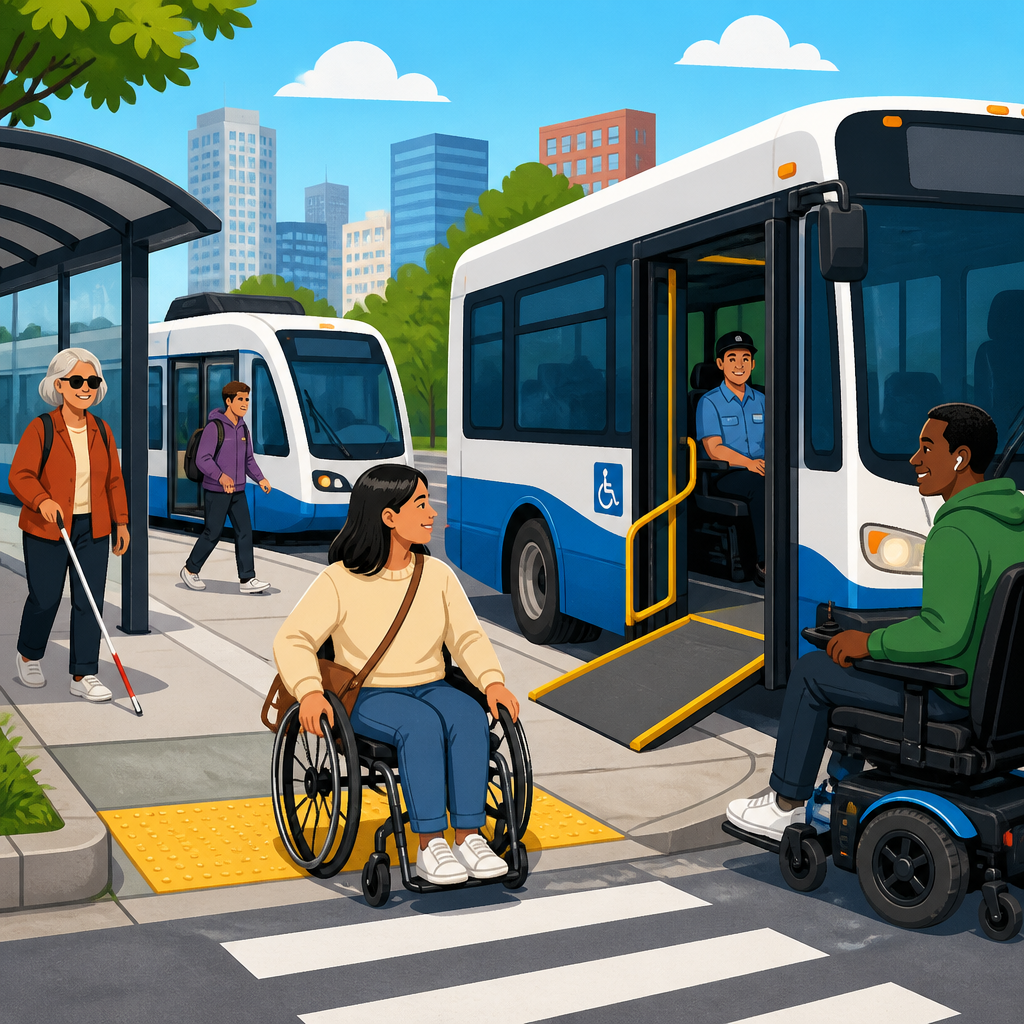
Transportation accessibility is becoming one of the most consequential fronts in Americans with Disabilities Act compliance because the systems people rely on every day are being redesigned at the same time expectations for equal access are rising. In practice, transportation accessibility means buses, rail, sidewalks, stations, airports, paratransit, ride-hailing, and emerging mobility services can be used safely and independently by people with mobility, sensory, cognitive, and other disabilities. The ADA established the baseline for nondiscrimination in public life, but transportation has always been where legal standards, infrastructure limits, and daily lived experience collide most visibly. After years of advising organizations on access planning, I have seen the same pattern repeatedly: when transportation works, employment, healthcare, education, and civic participation improve; when it fails, every other accessibility investment is weakened.
This is why transportation accessibility will be a bigger ADA story in the years ahead. The issue is no longer limited to installing a lift on a bus or providing a complementary paratransit trip. Transit agencies are modernizing fleets, cities are rebuilding streets, airports are digitizing customer journeys, and private mobility companies are expanding services that now function like public infrastructure. At the same time, enforcement pressure is increasing. The Department of Justice, the Department of Transportation, the Federal Transit Administration, and disability rights advocates are paying closer attention to maintenance failures, unreliable elevators, inaccessible websites and apps, inadequate wayfinding, and service design that excludes disabled riders in practice even when policy looks compliant on paper.
Future trends and predictions in ADA developments increasingly point to transportation because access to movement determines access to opportunity. Demographic changes matter here. The United States is aging, chronic conditions are more common, and more people expect to travel with mobility devices, service animals, captioning, audio prompts, and flexible assistance. Climate adaptation and infrastructure spending also matter because major capital projects create rare chances to correct barriers that have persisted for decades. As a hub for updates and developments, this article explains the forces making transportation a larger ADA priority, the standards and technologies shaping decisions, and the questions leaders should prepare to answer now.
Why transportation is moving to the center of ADA enforcement
Transportation is moving to the center of ADA enforcement because it combines high public visibility with measurable operational obligations. Unlike many accessibility issues that surface only occasionally, transit barriers happen at scale every day: broken elevators strand riders, inaudible announcements cause missed stops, bus stop pads are unusable for wheelchair boarding, and inaccessible trip-planning apps prevent independent travel before a journey begins. Under Title II of the ADA, public entities must provide equal access to services, programs, and activities. For transit agencies, that duty intersects with Department of Transportation regulations in 49 CFR Parts 27, 37, and 38, which cover vehicle accessibility, paratransit, and facility requirements.
In recent years, I have watched complaints shift from single-feature disputes to system-performance claims. Riders and advocates increasingly focus on whether the entire travel chain works. A rail station with a compliant platform is not meaningfully accessible if its only elevator is out of service for weeks. A bus system with accessible vehicles is not fully usable if stop announcements are inconsistent or operators bypass riders using mobility devices. This emphasis on reliability is crucial. Courts and regulators are more willing to ask whether an agency’s processes, maintenance practices, staffing, and procurement decisions create recurring exclusion. That makes transportation an especially dynamic ADA story because operational discipline matters as much as physical design.
The legal and policy trends that will drive the next wave
Several legal and policy trends will make transportation accessibility a larger focus. First, infrastructure investment is generating unprecedented scrutiny. When agencies accept federal funds to rebuild stations, buy railcars, redesign corridors, or improve bus stops, accessibility can no longer be treated as a narrow compliance checkpoint. It must be integrated into project scoping, public engagement, procurement specifications, construction sequencing, and post-launch monitoring. The Rehabilitation Act, ADA obligations, and agency-specific funding conditions often operate together, raising both risk and opportunity.
Second, public rights-of-way standards are influencing expectations even where local implementation remains uneven. Sidewalks, curb ramps, pedestrian signals, detectable warnings, and street crossings are central to transportation accessibility because the journey starts before boarding. The U.S. Access Board’s Public Right-of-Way Accessibility Guidelines have shaped best practices for years, and many jurisdictions now use them as a planning reference even before every element is uniformly codified. Third, digital accessibility is becoming inseparable from transportation access. Trip planners, mobile ticketing, service alerts, microtransit booking, airport kiosks, and wayfinding tools must work with screen readers, voice control, captions, color contrast requirements, and plain-language design.
Fourth, climate resilience and emergency planning are changing the conversation. Heat, flooding, smoke events, and severe storms hit disabled riders hardest when evacuation routes, backup communications, and alternative service plans are inaccessible. Agencies that once treated emergency accessibility as a specialized issue are now building it into continuity planning. Finally, enforcement is becoming more data-driven. Agencies are expected to track elevator uptime, complaint resolution, on-time paratransit performance, call center responsiveness, operator training completion, and accessibility defects at stops and stations. The next wave of ADA developments in transportation will be defined by documented outcomes, not generic statements of commitment.
Technology will expand access, but only when design is disciplined
New technology can dramatically improve transportation accessibility, but it can also scale exclusion faster than older systems ever could. The most important trend is the migration of core rider functions into digital channels. Riders now discover routes, compare travel times, purchase fares, request assistance, unlock shared vehicles, and receive disruption alerts through apps. If these interfaces are inaccessible, the barrier appears before the person reaches the curb. In my work, the most successful agencies treat digital tools as essential transportation infrastructure and test them accordingly using WCAG standards, assistive technology, and disabled user feedback.
Artificial intelligence will also influence accessibility. Real-time speech-to-text can improve announcements and customer support. Computer vision may help detect blocked pathways or broken platform equipment. Predictive maintenance can reduce elevator outages that disproportionately affect riders with mobility impairments. Yet AI introduces risks: automated customer service can mishandle disability-related requests, voice systems can fail for users with speech differences, and algorithmic dispatching can unintentionally lengthen wait times for paratransit riders. Transportation providers should require accessibility acceptance criteria in vendor contracts, conduct human-centered usability testing, and keep non-digital service options available.
| Trend | Accessibility opportunity | Primary risk if unmanaged |
|---|---|---|
| Mobile ticketing | Independent fare purchase and reduced queueing | Screen reader failures or inaccessible account verification |
| Real-time alerts | Immediate notice of delays, platform changes, and outages | Alerts delivered only visually or in complex language |
| Predictive maintenance | Fewer elevator and escalator breakdowns | Poor data quality hides recurring accessibility failures |
| On-demand transit platforms | Flexible trip booking in lower-density areas | Insufficient wheelchair-accessible vehicle availability |
The lesson is straightforward: technology does not make a transportation system accessible by default. Accessible outcomes come from procurement language, testing protocols, maintenance funding, and accountability measures. Agencies that treat accessibility as a product requirement rather than a post-launch patch will set the standard others are forced to follow.
Public transit, paratransit, and the pressure for reliability
Public transit and paratransit will remain the most visible arena for ADA developments because they expose the tension between minimum compliance and practical usability. Fixed-route bus and rail systems must support boarding, securement, stop announcements, accessible information, and station access. Complementary paratransit must be comparable to fixed-route service in response time, fares, service area, and trip purpose. Those principles are established, but the bigger story ahead is reliability. Riders increasingly expect agencies to prove that accessible features function consistently, not merely that they exist.
Consider elevator outages in legacy rail systems. A station may technically meet design requirements, yet repeated breakdowns can sever access to employment corridors for weeks. Agencies that publish elevator status feeds, provide staff-assisted alternatives, and prioritize redundancy are responding to a real legal and operational risk. The same applies to bus stop accessibility. A low-floor bus is not enough if the stop lacks a firm boarding surface or is blocked by utility poles and snow storage. I have seen agencies reduce complaints quickly by auditing stop conditions route by route and coordinating with public works departments rather than treating the bus itself as the whole accessibility solution.
Paratransit will receive renewed attention as agencies balance cost, demand, and rider dignity. Software can improve scheduling, but excessive shared rides, long pickup windows, and weak communication still undermine comparability. The strongest systems measure no-show disputes, trip denials, on-time performance, and complaint themes, then adjust service design. Future ADA scrutiny will focus on whether agencies use data to improve rider outcomes, especially for dialysis patients, workers on fixed schedules, students, and people making spontaneous community trips.
Private mobility, airports, and the expanding definition of transportation access
Another reason transportation accessibility will be a bigger ADA story is that the transportation ecosystem now extends far beyond traditional public transit. Ride-hailing, taxi networks, bike and scooter share, intercity bus, passenger rail, and airport services all shape whether a disabled traveler can complete a trip. The legal frameworks vary, but the practical expectation is converging: if a service functions as a mainstream mobility option, accessibility can no longer be peripheral. That expectation is being reinforced by litigation, local regulation, settlement agreements, and public pressure.
Ride-hailing companies illustrate the point. Consumers increasingly view these platforms as essential mobility tools, yet wheelchair-accessible vehicle supply remains inconsistent in many markets, and app workflows for requesting accommodations can be confusing. Airports present a parallel challenge. Although air travel is primarily governed by the Air Carrier Access Act rather than the ADA, airport terminals, parking, shuttle systems, concessions, kiosks, and digital navigation often implicate ADA responsibilities for airport operators and tenants. Wheelchair mishandling, inaccessible self-service technology, poor hearing-loop deployment, and inadequate wayfinding are pushing airports to treat accessibility as a customer experience priority, not just a legal one.
Micro-mobility and curb management will also become more prominent. Shared scooters parked across curb ramps, inaccessible docking design, and loading zones that ignore paratransit needs can negate expensive street improvements. Cities that manage the curb as an accessibility asset, with designated pickup space, enforcement, and clear pedestrian paths, are better positioned for the next generation of ADA expectations.
What organizations should do now to prepare
Organizations should prepare for this shift by auditing the full travel chain, not isolated assets. Start with the rider journey: planning, booking, payment, arrival at the stop or station, boarding, onboard communication, transfers, disruptions, and complaint resolution. Each step should be tested by disabled users with different needs, including wheelchair users, blind and low-vision riders, deaf and hard-of-hearing riders, and people with cognitive disabilities. Internal links across policy teams matter too. Capital projects, IT, procurement, training, communications, risk management, and operations must work from the same accessibility standards and incident data.
Second, set measurable performance targets. Track elevator uptime, lift repair times, accessible stop conditions, digital defect resolution, staff training completion, and paratransit on-time performance. Third, modernize procurement language. Require WCAG conformance for digital tools, accessibility testing for kiosks, maintenance response commitments for vertical transportation, and vendor cooperation in complaint investigations. Fourth, publish transparent information for riders in plain language. Clear outage notices, alternative route guidance, and accessible customer support reduce both harm and legal exposure.
The central takeaway is simple: transportation accessibility will be a bigger ADA story because movement is the foundation of equal participation, and the systems that enable movement are being rebuilt in real time. Legal standards are tightening in practice through enforcement, infrastructure spending is exposing longstanding barriers, and technology is raising both the ceiling for independence and the stakes of poor design. The organizations that lead in this area will not be the ones that chase complaints after launch. They will be the ones that treat accessibility as an operational metric, a design requirement, and a public promise.
For readers following future trends and predictions in ADA developments, transportation should be the subtopic to watch most closely. It connects sidewalks to stations, apps to vehicles, maintenance logs to civil rights, and emergency planning to everyday dignity. The benefit of getting it right is concrete: more people can work, study, receive care, travel, and participate in community life without depending on unreliable workarounds. Review your transportation touchpoints now, identify the weakest links in the journey, and use this hub as the starting point for deeper updates across the broader accessibility landscape.
Frequently Asked Questions
Why is transportation accessibility becoming a bigger ADA issue now?
Transportation accessibility is becoming a bigger ADA story because mobility systems across the country are changing quickly at the same time public expectations around equal access are rising. Cities, transit agencies, airports, and private mobility companies are redesigning stations, upgrading fleets, rebuilding sidewalks, digitizing trip planning, and introducing new on-demand services. Whenever systems are modernized, the question is no longer just whether they technically exist for disabled riders, but whether they are genuinely usable, reliable, and independent in day-to-day life. That puts accessibility at the center of ADA compliance rather than at the margins.
Another reason this issue is expanding is that transportation affects nearly every other area of civic life. If a person cannot reliably get to work, school, medical care, public services, or community events, equal access in those settings is weakened too. In other words, inaccessible transportation can create a chain reaction of exclusion. That is why barriers such as broken elevators, inaccessible bus stops, missing curb ramps, poor audio announcements, confusing wayfinding, and digital platforms that do not work with assistive technology are receiving more legal, regulatory, and public attention than before.
There is also growing recognition that accessibility is not limited to wheelchair access alone. Compliance increasingly involves the needs of people with vision, hearing, cognitive, neurological, and dexterity-related disabilities, as well as older adults and others with functional limitations. As transportation options become more interconnected, the ADA conversation is broadening from isolated design features to the full rider experience. That includes booking a trip, reaching the stop, boarding safely, receiving usable information, managing disruptions, and completing the trip independently. That broader view is a major reason transportation accessibility will continue to be a significant ADA focus.
What kinds of transportation systems and services are covered in accessibility discussions under the ADA?
Accessibility discussions under the ADA can involve a wide range of transportation systems, both public and private. Public transit is a major category, including fixed-route buses, rail systems, subways, commuter trains, paratransit, stations, platforms, parking areas, and related passenger facilities. But the conversation does not stop there. Sidewalks, curb ramps, pedestrian signals, crosswalks, and connections between modes are all critical because a trip is only accessible if the person can actually reach and navigate the transportation system in the first place.
Airports and airport ground transportation are also part of the practical accessibility landscape, especially when travelers move between terminals, shuttles, parking, drop-off zones, and public transit links. In many communities, accessibility questions also arise with taxi programs, ride-hailing apps, microtransit, bike-share and scooter programs, and other emerging mobility services. Even when legal frameworks differ depending on the provider or mode, the core concern remains the same: can disabled people use these services safely, effectively, and with a degree of independence comparable to others?
Importantly, accessibility also includes the digital and operational layers of transportation. Websites, mobile apps, real-time service alerts, payment systems, kiosks, customer service channels, and emergency communications can all create barriers if they are not designed inclusively. A theoretically accessible bus route, for example, may still be functionally inaccessible if route changes are only posted visually, if trip-booking software is not screen-reader compatible, or if riders cannot obtain understandable information during delays. That is why transportation accessibility is increasingly evaluated as a system-wide issue rather than just a question of vehicle design.
What are the most common transportation accessibility barriers people with disabilities still face?
Some of the most common barriers are surprisingly basic, but they have serious consequences. Riders may encounter missing or damaged curb ramps, uneven sidewalks, inaccessible bus stops without safe boarding space, stations without working elevators, platforms with dangerous gaps, or transit vehicles with ramps or lifts that are unavailable or poorly maintained. These conditions can turn an ordinary trip into an unsafe or impossible one. For a person with a mobility disability, a single blocked path or out-of-service elevator can force long detours, missed appointments, or complete trip cancellation.
People with sensory disabilities often face a different but equally disruptive set of problems. A rider who is blind or has low vision may struggle when signage is unclear, wayfinding is inconsistent, or route and stop information is not announced audibly. A rider who is deaf or hard of hearing may miss service changes or safety instructions if information is delivered only through audio. In crowded and fast-moving environments like stations or airports, inaccessible communication can create confusion, stress, and safety risks. These are not minor inconveniences; they go directly to equal participation and independent travel.
Cognitive and neurological accessibility is also gaining more attention. Complex ticketing systems, unpredictable service patterns, cluttered station layouts, unclear instructions, and app interfaces that are difficult to understand can make transportation unnecessarily difficult for people with intellectual, developmental, cognitive, or mental health-related disabilities. In addition, many riders experience compounded barriers. For example, a person may face both physical obstacles in the built environment and inaccessible digital tools needed to plan the trip. The most persistent challenge is often not one dramatic barrier, but a chain of smaller failures that collectively make the system unreliable. Reliability matters because accessibility under the ADA is meaningful only when people can depend on it consistently, not occasionally.
How do ride-hailing, paratransit, and newer mobility services fit into the ADA accessibility conversation?
Ride-hailing, paratransit, and newer mobility services are a growing part of the ADA conversation because they increasingly function as essential transportation, not just optional convenience. Traditional public transit remains central, but many people now rely on app-based platforms, demand-responsive services, and first-mile or last-mile connections to complete everyday trips. As these services become more common, the accessibility question becomes harder to avoid: if modern mobility options shape how people get around, disabled riders cannot be left with fewer, slower, or less reliable choices than everyone else.
Paratransit has long been a critical service for riders whose disabilities prevent them from using fixed-route transit under certain conditions. But users often report challenges involving advance scheduling, long pickup windows, trip denials, extended ride times, and service area limits. Those operational issues matter because access is not just about the existence of a service; it is also about whether the service works in a way that supports employment, healthcare, education, and spontaneous daily life. A transportation option that is technically available but operationally burdensome can still leave riders at a serious disadvantage.
With ride-hailing and emerging mobility platforms, accessibility concerns often center on wheelchair-accessible vehicle availability, equitable wait times, driver training, service animal acceptance, app usability, and nondiscriminatory policies. Similar concerns can arise with airport shuttles, microtransit, and shared mobility programs. As public and private transportation ecosystems become more blended, organizations may face greater scrutiny over whether accessibility has been integrated into service design from the beginning. The broader trend is clear: transportation access is being judged less by labels such as public, private, or innovative, and more by whether disabled people can actually use the service with dignity, safety, and independence.
What should transportation agencies, municipalities, and mobility providers do to improve ADA accessibility?
The most effective starting point is to treat accessibility as a core design and operations issue rather than a limited compliance checklist. That means evaluating the entire travel chain: sidewalks and curb ramps leading to stops, stop and station design, boarding conditions, signage, announcements, digital tools, customer service, emergency procedures, and maintenance practices. A system is only as accessible as its weakest link. Agencies and providers should look beyond whether a feature exists on paper and examine whether riders can depend on it in real conditions, during peak hours, service disruptions, and routine maintenance cycles.
They should also prioritize proactive audits, barrier-removal planning, and meaningful engagement with disabled riders. Input from people who use mobility devices, screen readers, hearing aids, service animals, or cognitive supports often reveals obstacles that standard inspections miss. This feedback is especially important when redesigning stations, deploying mobile apps, changing route structures, procuring vehicles, or introducing new service models. Training front-line employees matters just as much as physical upgrades. Operators, station staff, customer support teams, and contracted drivers need practical guidance on communication, equipment use, service-animal rules, and respectful interaction. Poor implementation can undermine even a well-designed system.
Finally, organizations should understand that accessibility is an ongoing responsibility, not a one-time project. Elevators break, software updates introduce new barriers, weather affects pathways, and service changes can disrupt carefully planned accommodations. Strong accessibility programs include preventive maintenance, transparent reporting, rapid response to outages, alternative access plans, and regular review of policies and technologies. The organizations that will be best positioned in this growing ADA landscape are the ones that build accessibility into planning, budgeting, procurement, operations, and public communication from the start. That approach reduces legal exposure, but just as importantly, it creates transportation systems that more people can actually use every day.


