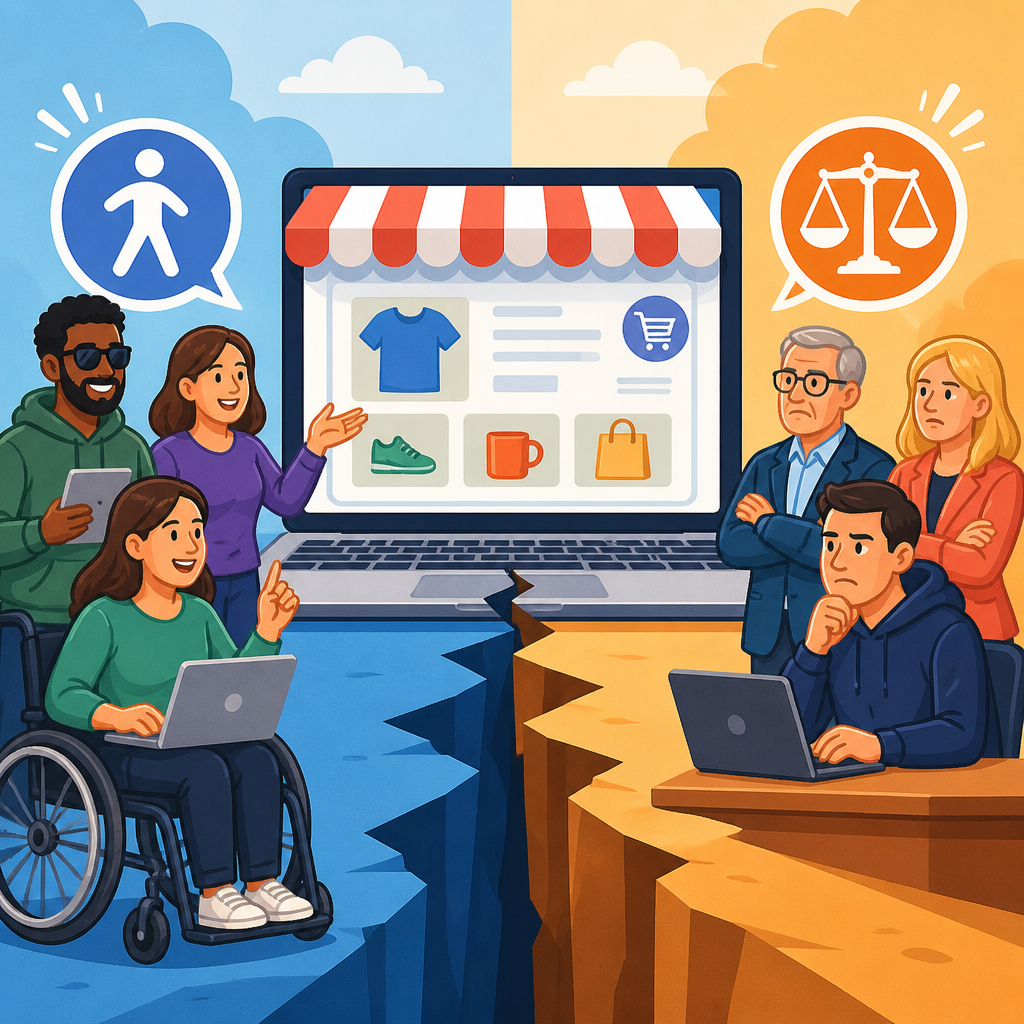
The question of whether online-only businesses must comply with Title III of the Americans with Disabilities Act remains one of the most contested issues in modern accessibility law. Title III prohibits disability discrimination by places of public accommodation, a phrase rooted in a 1990 statute written before streaming platforms, app-based services, digital marketplaces, and software subscriptions became central to daily commerce. Courts, regulators, businesses, and disability advocates have spent years debating how that language applies when a company has no storefront, no ticket counter, and no physical customer-facing location. The result is a continuing split across jurisdictions, a rising volume of litigation, and a compliance landscape that is both urgent and uneven.
For companies operating online, this debate matters because the legal risk is real even where the doctrinal rules are unsettled. Plaintiffs have filed thousands of digital accessibility suits over websites, mobile apps, online reservation systems, payment portals, and streaming content. Some claims focus on screen-reader barriers, keyboard traps, missing form labels, inaccessible PDFs, absent captions, or checkout flows that cannot be completed without a mouse. Others challenge policies, such as requiring identity verification through inaccessible visual prompts. In practice, many businesses discover the issue only after a demand letter arrives. I have seen legal teams assume that accessibility can wait until a redesign, only to learn that an inaccessible login sequence or coupon field can trigger immediate claims.
Understanding the split starts with a few key terms. Title III covers private entities that own, lease, or operate places of public accommodation, including hotels, restaurants, theaters, retail stores, service establishments, schools, and health care providers. Digital accessibility means people with disabilities can perceive, operate, understand, and robustly interact with online content, often measured against the Web Content Accessibility Guidelines, especially WCAG 2.1 AA and increasingly WCAG 2.2. The “nexus” theory holds that a website or app falls under Title III when it has a sufficient connection to a physical place of public accommodation. The broader view holds that some online services can themselves be public accommodations, even without a physical site open to customers.
This article serves as a hub for recent ADA litigations and emerging trends within the legal cases and precedents landscape. It explains the current split, highlights influential rulings, identifies litigation patterns, and shows where courts, enforcement agencies, and private plaintiffs are heading. For in-house counsel, founders, product leaders, compliance officers, and marketers, the central lesson is simple: the absence of a uniform national rule does not reduce the need for accessibility. It increases it, because uncertainty raises both litigation exposure and operational friction. Businesses that treat accessibility as a core product requirement are consistently in a stronger position than those waiting for a definitive Supreme Court answer.
Why courts disagree on online-only coverage under Title III
The split exists because the statutory text lists categories of public accommodation in language that sounds physical: bakery, grocery store, theater, gymnasium, pharmacy, and similar establishments. One line of cases reads that wording narrowly. Under this approach, Title III targets barriers at physical places, so a stand-alone website or app is not covered unless it impedes access to a brick-and-mortar location. Courts following this reasoning often require a nexus between the digital service and a physical place. If a grocery chain’s website blocks prescription refills or a retailer’s app prevents in-store pickup scheduling, the digital barrier may violate Title III because it interferes with access to a covered physical business.
The competing line of cases reads the statute more functionally. These courts emphasize that the listed categories describe types of businesses offering goods and services to the public, not merely buildings. From that perspective, an online-only streaming service, educational platform, or digital retailer can fit within categories such as sales establishment, service establishment, place of exhibition, or place of entertainment. Supporters of this view also note the ADA’s broad remedial purpose: eliminating disability-based exclusion from economic and social life. A rule limiting coverage to entities with doors and counters would leave major segments of commerce outside the statute just because technology changed faster than legislative wording.
Judges also diverge over method. Textualist opinions tend to scrutinize the statutory list and compare online services to named examples. Purposive opinions often stress the ADA’s anti-discrimination objective and the practical consequences of excluding web-based businesses. The Department of Justice has consistently taken the position that Title III applies to websites and online services of public accommodations, and although its rulemaking history has been uneven, its enforcement posture has reinforced broader interpretations. Yet because there is no final DOJ regulation setting technical standards for all Title III websites, courts still resolve claims through general statutory interpretation, existing case law, and factual allegations about barriers and harm.
Key cases shaping the online-only debate
Several cases define the present landscape. In Robles v. Domino’s Pizza, the Ninth Circuit held that Title III applied to Domino’s website and app because of their connection to physical restaurants. The court rejected due process objections tied to the absence of formal DOJ web regulations and allowed the suit to proceed, making clear that businesses can be liable even without a government-issued technical rulebook. Although Robles did not decide the online-only question directly, it accelerated digital accessibility litigation by confirming that web and app barriers can create actionable Title III claims when they affect access to goods and services of a physical location.
In the First Circuit, Carparts Distribution Center v. Automotive Wholesaler’s Association has long been cited for a broader interpretation. That case suggested public accommodations are not limited to actual physical structures, reasoning that restricting coverage to physical sites would produce arbitrary results. Plaintiffs suing online-only companies often rely on Carparts and later district court opinions influenced by it. One frequently discussed example is the litigation against Netflix in Massachusetts, where the court allowed claims over allegedly inaccessible streaming content to proceed under a broader reading of Title III. By contrast, a California federal court reached the opposite conclusion in separate Netflix litigation, illustrating the doctrinal fracture in especially concrete form.
The Eleventh Circuit’s path has been particularly influential and at times confusing. In Gil v. Winn-Dixie, an initial panel opinion adopted a narrow approach to websites and public accommodation, but that opinion was later vacated, limiting its precedential force. Even so, litigants continue to debate its reasoning because it reflects the narrower camp’s concerns about extending Title III beyond physical places. Other courts in the Second, Seventh, and Ninth Circuits have generated rulings that, while not always addressing online-only businesses squarely, shape pleading standards, mootness arguments, standing requirements, and remediation expectations. The practical takeaway is that no single decision resolves the issue nationally; outcomes still depend heavily on forum and facts.
| Issue | Narrower View | Broader View | Practical Effect |
|---|---|---|---|
| What is a public accommodation? | A physical place or something tied closely to one | A business offering covered goods or services to the public, even online | Changes whether online-only companies face Title III claims at all |
| Website or app coverage | Covered only with a nexus to a store, office, or venue | Can be covered on its own | Determines pleading strategy and forum selection |
| Role of WCAG | Useful benchmark, not always mandated | Useful benchmark, often central to settlement terms | Shapes remediation scope and vendor requirements |
| Business risk | Lower in some jurisdictions, not zero | Higher and more immediate | Encourages nationwide accessibility programs despite legal split |
Recent ADA litigations and emerging trends businesses should track
Recent ADA litigations show that plaintiffs are targeting more than homepages and retail carts. Claims now regularly involve mobile applications, third-party integrations, loyalty systems, account dashboards, appointment scheduling tools, biometric sign-in flows, chat widgets, and embedded video players. Subscription businesses are frequent targets because recurring customer interactions amplify barriers. If a blind user cannot manage billing, cancel a plan, or review purchase history, the accessibility problem is ongoing rather than isolated. I have also seen demand letters increasingly reference inaccessible overlays, arguing that toolbars marketed as quick fixes do not correct underlying code defects and may create additional usability issues.
Another trend is the move from pure injunctive-relief cases toward broader litigation portfolios combining federal ADA claims with state-law damages theories. California’s Unruh Act remains especially significant because it can attach statutory damages to accessibility violations, making website suits more expensive to defend and settle. New York has likewise remained active for digital accessibility filings. Plaintiffs’ firms have become more sophisticated in testing websites with screen readers such as JAWS, NVDA, and VoiceOver, and complaints now often identify precise failures: unlabeled edit fields, inaccessible modal dialogs, missing alternative text, focus-order problems, or CAPTCHA barriers without an accessible alternative. These technical specifics can make early dismissal harder.
Standing and mootness are still major battlegrounds. Defendants often argue that a plaintiff did not genuinely intend to use the service, encountered only minor issues, or lacks standing to seek forward-looking relief. Plaintiffs respond by documenting repeat visits, attempted purchases, or specific reasons for returning. Mootness arguments typically arise after a business remediates the challenged barriers, but courts vary on whether fixes are complete, durable, and independently verified. A rushed patch rarely ends the case if broader systemic issues remain. That is why mature accessibility programs now include audits, regression testing, design-system controls, procurement standards, and written governance rather than one-time remediation sprints tied only to litigation.
What this split means for online-only companies, platforms, and counsel
For online-only businesses, the central mistake is assuming that jurisdictional uncertainty equals safety. It does not. A company may be sued where the plaintiff files, where customers access the service, or where state law creates additional exposure. Even if a defense based on lack of physical nexus is viable, it may fail early, increase costs, and damage reputation. More importantly, inaccessible products lose customers. Roughly one in four adults in the United States lives with some form of disability, according to the Centers for Disease Control and Prevention. That is not a niche audience. In sectors like banking, telehealth, education, travel, and entertainment, accessibility directly affects conversion, retention, and customer support volume.
The most effective response combines legal risk assessment with technical implementation. Start by mapping user journeys that matter most: account creation, sign-in, search, product comparison, checkout, billing, customer support, and document access. Test those flows against WCAG 2.1 AA at minimum, while planning for WCAG 2.2 success criteria that address focus appearance, drag alternatives, and target size concerns. Use both automated tools and manual testing. Axe, WAVE, Lighthouse, and Accessibility Insights can surface code-level issues, but only human review catches context failures such as ambiguous link text, misleading headings, broken screen-reader announcements, or inaccessible error recovery. Include disabled users in research where possible; nothing replaces task-based usability evidence.
Documentation matters as much as fixes. Courts and counterparties respond better when a business can show an accessibility policy, assigned ownership, periodic audits, engineering standards, training records, vendor obligations, and a roadmap with deadlines. If a company relies on third-party payment processors, booking engines, or identity tools, contracts should address accessibility warranties, remediation obligations, and testing cooperation. Product teams should treat accessible components as part of the design system, not optional add-ons. In my experience, organizations reduce risk fastest when they move accessibility upstream into procurement, design QA, and release management. Waiting until a complaint arrives usually means remediation under compressed timelines, higher legal spend, and weaker evidence of good-faith compliance.
Where the law may move next
The long-term direction points toward broader digital coverage, even if the doctrinal route differs by court. Commerce has shifted online so completely that limiting Title III to businesses with customer-facing real estate looks increasingly detached from how people actually buy goods, obtain services, learn, work, and receive care. Federal agencies have signaled similar thinking. The Department of Justice has repeatedly supported website accessibility enforcement under the ADA, and the Department of Health and Human Services adopted a rule for Section 504-covered entities incorporating WCAG 2.1 AA for web and mobile content, reinforcing the role of recognized technical standards across regulated sectors.
That said, a clean nationwide rule may still take time. Congress could amend the ADA to address digital services explicitly, the DOJ could pursue broader rulemaking, or the Supreme Court could eventually resolve the split if a suitable case reaches it. Until then, lower-court variation will continue. Businesses should watch not only appellate rulings, but also settlement trends, state accessibility laws, agency statements, and procurement requirements from enterprise customers. Many companies are effectively being pulled toward accessibility by contract before a court ever orders it. Large buyers increasingly require VPATs based on the Voluntary Product Accessibility Template and expect conformance evidence during vendor review, especially in education, government, and health care.
The practical conclusion is straightforward. Online-only businesses should act as though accessibility obligations apply, because the legal, commercial, and operational case for doing so is already strong. The ongoing split over Title III is important, but it should not be used as a delay tactic. Recent ADA litigations and emerging trends show a clear pattern: plaintiffs are getting more specific, courts are engaging deeply with digital barriers, and accessible product development is becoming a baseline business expectation. If this article is your starting point within the legal cases and precedents hub, the next step is to review the related case analyses, compare jurisdictional approaches, and audit your highest-value user flows before the law forces the issue.
Frequently Asked Questions
1. Why is there still so much disagreement over whether online-only businesses are covered by Title III of the ADA?
The disagreement exists because Title III of the Americans with Disabilities Act was enacted in 1990, long before websites, mobile apps, streaming services, cloud platforms, and online marketplaces became central to commerce. The statute prohibits discrimination by “places of public accommodation,” and that phrase has become the focal point of the debate. Some courts read it broadly, reasoning that modern businesses can provide goods and services to the public entirely online and should not be able to avoid accessibility obligations simply because they lack a storefront. Other courts read the law more narrowly and focus on the statute’s text, which lists categories such as hotels, restaurants, theaters, retail stores, and service establishments that traditionally suggest physical locations.
This divide has produced different legal standards across jurisdictions. In some places, a website or app may be treated as independently subject to Title III if it functions like a public-facing business. In others, plaintiffs may need to show a connection, often called a “nexus,” between the digital service and a physical place of public accommodation. That means the same online business may face very different legal exposure depending on where a lawsuit is filed. The issue remains unsettled because Congress has not amended Title III to expressly address online-only operations, and although regulators have repeatedly emphasized digital accessibility as an important civil rights issue, a single uniform nationwide rule for online-only businesses under Title III has not fully resolved the split.
2. What does the “nexus” theory mean, and why does it matter in website accessibility cases?
The “nexus” theory is a legal approach under which a website, app, or digital platform falls within Title III when it has a sufficient connection to a physical place of public accommodation. Under this view, the ADA clearly applies to a brick-and-mortar business such as a retailer, bank, hotel, restaurant, or medical office, and its digital tools must also be accessible when they act as gateways to the goods or services of that physical location. For example, if a customer uses a website to book a hotel room, refill a prescription, order groceries for pickup, or access rewards tied to a store, a court applying the nexus theory may conclude that inaccessible digital features can unlawfully impede access to the underlying physical business.
This matters because the nexus approach often determines whether a plaintiff can proceed at all. In jurisdictions that require a nexus, online-only companies may argue that they operate without any physical public-facing place and therefore do not fall within Title III. By contrast, businesses with stores, offices, or facilities open to the public may face stronger claims that their websites and apps must be accessible because those digital tools are part of the customer experience. The theory has become especially important as courts try to fit modern technology into statutory language drafted decades ago. Even where a nexus is required, the practical takeaway for businesses is significant: if the website or app helps users access products, services, reservations, payments, or customer support associated with a physical business, accessibility is much more likely to be treated as a Title III issue.
3. If a business operates only online, does that mean it is free from ADA accessibility obligations?
Not necessarily. The most accurate answer is that online-only businesses operate in a legally uncertain environment, not in a guaranteed safe harbor. Some courts have been willing to interpret Title III broadly enough to cover businesses that offer goods or services exclusively through digital channels, especially where the business functions like a public marketplace or service provider open to the general public. Those courts often emphasize the ADA’s remedial purpose and the practical reality that excluding disabled users from digital commerce can be as harmful as excluding them from a physical store.
At the same time, other courts have concluded that Title III’s text is tied to physical places, making it harder to apply the law to online-only entities absent legislative change. That means a business with no storefront, office open to customers, or physical service location may have stronger arguments in some jurisdictions than in others. But even when the law is unsettled, online-only businesses still face meaningful risk. They may be sued in plaintiff-friendly jurisdictions, face state-law accessibility claims, encounter demand letters, lose customers, damage their brand reputation, or draw regulatory scrutiny depending on the circumstances. In addition, many accessibility disputes settle long before a final appellate decision, so the practical business question is often less about theoretical immunity and more about risk management. For that reason, many online-only businesses choose to improve accessibility regardless of the current split, both to reduce legal exposure and to make their services usable by a broader audience.
4. How are regulators and disability advocates influencing the debate over online-only businesses and Title III?
Regulators and disability advocates have played a major role in pushing the legal conversation toward broader recognition of digital accessibility. Disability rights organizations consistently argue that the ADA is a civil rights law meant to ensure equal access to participation in society, and in today’s economy that includes websites, mobile apps, digital subscriptions, telehealth platforms, online education, streaming content, and e-commerce. Their position is that excluding digital services from Title III would undermine the law’s purpose by allowing businesses to move essential services online while avoiding accessibility responsibilities.
Federal regulators, particularly the Department of Justice, have also repeatedly expressed the view that the ADA applies to web accessibility, even though the exact reach of Title III for online-only businesses has remained contested in the courts. Regulatory statements, enforcement actions, and settlement agreements have helped shape expectations by signaling that digital barriers can amount to disability discrimination. While these actions do not erase the judicial split, they influence how businesses assess compliance and how courts understand the broader policy context. The advocacy community has also contributed through litigation, technical guidance, and public pressure, helping establish accessibility as a mainstream governance issue rather than a niche technical concern. As a result, even without a definitive nationwide ruling on every online-only scenario, the momentum in policy and advocacy circles strongly favors accessible digital design as the expected standard.
5. What should online-only businesses do now while the law remains unsettled?
Online-only businesses should treat accessibility as both a legal risk issue and a core operational priority. The most practical first step is to evaluate websites, mobile apps, customer portals, checkout flows, video content, and account features for accessibility barriers. Businesses commonly use the Web Content Accessibility Guidelines, or WCAG, as the leading benchmark for digital accessibility, even though Title III itself does not spell out a single technical standard in the statutory text. A thoughtful accessibility program usually includes automated testing, manual testing, keyboard navigation review, screen reader testing, captioning and transcript practices, color contrast analysis, and remediation of high-impact user barriers.
Beyond technical fixes, companies should adopt governance measures that show accessibility is being addressed systematically. That may include assigning internal responsibility, training designers and developers, including accessibility in procurement and vendor contracts, creating a public accessibility statement, offering a way for users to report problems, and documenting remediation efforts. These steps can improve the user experience, strengthen defenses in the event of a complaint, and reduce the likelihood that accessibility problems become entrenched over time. Even if a business believes Title III may not clearly apply in its jurisdiction, waiting for perfect legal certainty is often a poor strategy. The trend in commerce, enforcement, and public expectations points toward broader accessibility obligations, not fewer. Businesses that act early are generally better positioned than those that respond only after receiving a demand letter or lawsuit.


