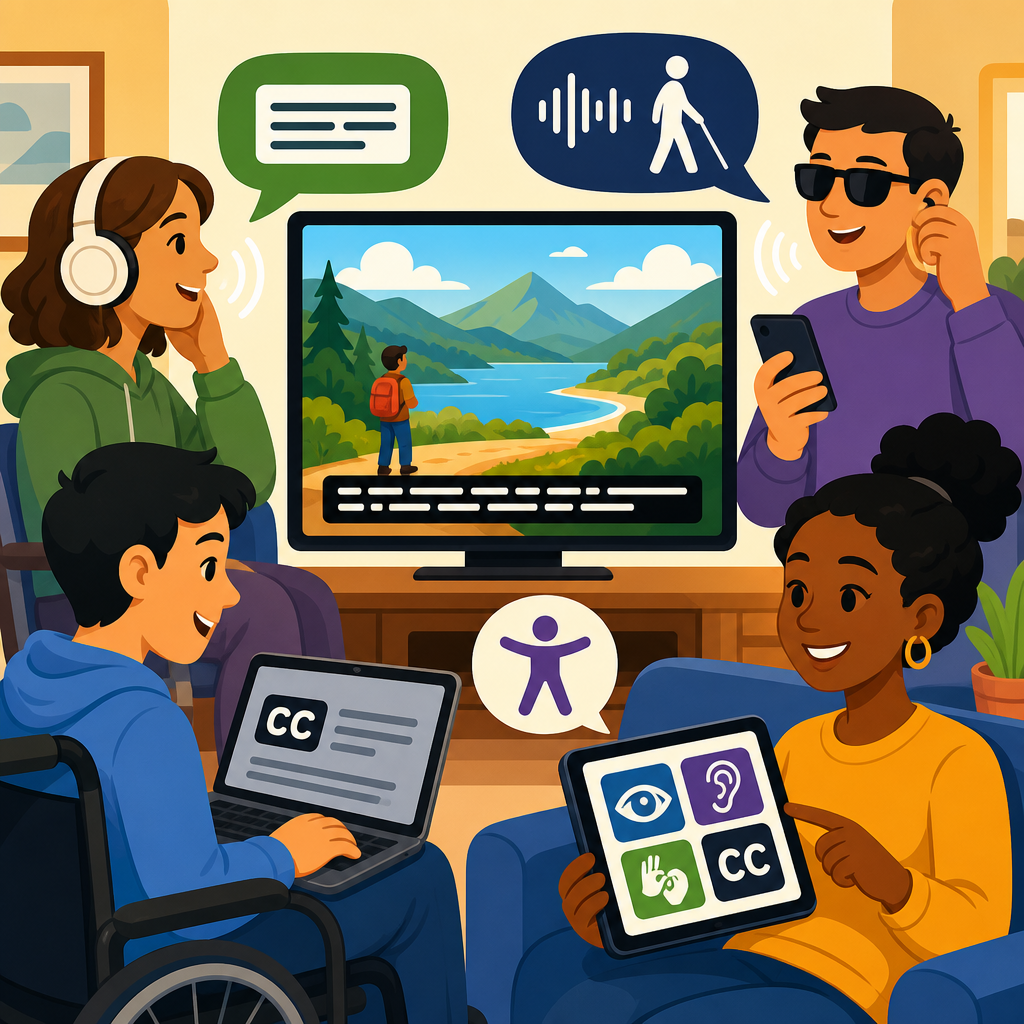
Caption quality, audio description, and digital media accessibility cases now sit at the center of modern ADA compliance because video, streaming, podcasts, webinars, and social clips have become core business communication channels. In this legal landscape, accessibility no longer means only adding captions or a transcript after publication. It means delivering equivalent access with sufficient accuracy, timing, completeness, and usability so deaf, hard of hearing, blind, and low-vision users can understand content without undue burden. I have worked with media teams responding to accessibility complaints, and the pattern is consistent: organizations usually underestimate quality standards, overestimate automated tools, and discover too late that digital media is treated as a public-facing service, not a side feature.
Three terms shape this area. Captions are synchronized text for spoken dialogue and relevant non-speech audio. Audio description is narrated information that explains meaningful visual details during natural pauses. Digital media accessibility is the broader practice of making video, audio, players, interfaces, archives, and live streams usable with assistive technology. These concepts matter because the ADA, Section 504, Section 508, state civil rights laws, and settlement agreements increasingly evaluate actual user access, not technical box-checking. Courts and regulators look at whether a person with a disability can perceive the content, operate the player, and receive information with substantially equivalent effectiveness.
This topic matters even more as organizations publish more dynamic media across websites, apps, learning platforms, and social channels. Plaintiffs have challenged universities over lecture capture systems, retailers over product videos, entertainment companies over streaming libraries, and public entities over emergency communications. Recent legal developments show a practical shift from asking whether media must be accessible to examining how accessible it must be, how quickly remediation must occur, and whether quality defects themselves create liability. For legal teams, accessibility officers, producers, and developers, this hub explains the emerging challenges and recent ADA legal developments that shape caption quality, audio description, and digital media accessibility cases.
The legal foundation behind digital media accessibility disputes
Most digital media accessibility cases arise under Title II or Title III of the ADA, often paired with Section 504 for federally funded entities and state statutes such as California’s Unruh Civil Rights Act. Title II applies to public entities, including state universities and local governments. Title III applies to private businesses that qualify as places of public accommodation or have sufficient nexus to public-facing services. In practice, media disputes often center on whether inaccessible videos, uncaptioned live streams, or missing audio description deny equal access to goods, services, programs, or activities.
Recent enforcement trends also rely on the Web Content Accessibility Guidelines as the operative benchmark, even where a statute or regulation does not explicitly codify every media detail. WCAG 2.1 and WCAG 2.2 include standards relevant to captions, prerecorded audio description, live captions, keyboard access, timing, and compatibility with assistive technologies. Although WCAG is not the ADA itself, it is the compliance language that appears repeatedly in demand letters, consent decrees, procurement policies, and internal remediation plans. That matters because courts and agencies often need a measurable standard, and media teams need one too.
The Department of Justice has reinforced that the ADA applies to websites, apps, and digital services, including media content embedded within them. For public entities, the 2024 DOJ rule on web and mobile app accessibility under Title II gave sharper operational direction, making digital content accessibility harder to postpone. Even for businesses under Title III, where a comprehensive technical rule remains absent, litigation and settlements continue to treat accessible media as a baseline expectation. The legal risk is therefore not hypothetical. It is active, recurring, and increasingly tied to media production workflows.
Why caption quality has become a legal issue, not just a production issue
Early accessibility disputes often focused on whether captions existed at all. Recent cases and complaints increasingly examine whether captions are accurate, synchronized, complete, and properly placed. Poor captions can omit critical dialogue, misidentify speakers, mistranscribe specialized terms, or lag behind speech enough to impair comprehension. In educational and legal contexts, those failures can alter meaning materially. I have seen auto-caption outputs turn medical terminology, product names, and financial figures into nonsense, creating exactly the kind of unequal access plaintiffs now point to as evidence of discrimination.
Quality matters because captions are not decorative. They are the primary access method for many users. If captions consistently miss proper nouns, fail to include meaningful sound cues, or disappear during rapid exchanges, the user receives an inferior version of the content. That becomes especially important in training videos, compliance modules, public hearings, and customer support media, where missing a single word can change the substance. Plaintiffs increasingly argue that defective captions are equivalent to missing captions because they deny effective communication rather than merely reducing convenience.
Courts and settlements often look to practical indicators of quality: verbatim or near-verbatim accuracy where necessary, synchronization with speech, inclusion of relevant non-speech information, and formatting that does not obscure on-screen content. Automated speech recognition can help scale captioning, but organizations that rely on automation alone assume significant legal risk. Human review remains the safest practice for high-value or high-risk content, especially when speech is fast, accented, technical, multilingual, or recorded in noisy environments. The emerging legal standard is straightforward: if users cannot reliably understand the media, the captions are not good enough.
Audio description claims are expanding beyond entertainment
Audio description disputes used to be associated mainly with film and broadcast access. That is no longer true. Universities, museums, retailers, health systems, and public agencies increasingly use highly visual video content for instruction, marketing, and service delivery. When a video relies on charts, demonstrations, text on screen, gestures, scene changes, or product visuals to convey meaning, blind and low-vision users may miss essential information without description. A transcript rarely solves that problem because it captures speech, not visual context.
Recent complaints emphasize that audio description is required when visual information is necessary to understand the content or complete a task. Consider a retailer’s assembly video that says “attach this part here” while showing the motion onscreen. Without description, the instruction is unusable. The same problem appears in software tutorials, telehealth explainers, safety training, and emergency preparedness videos. The access barrier is not abstract; it prevents independent participation. That practical harm is why audio description is becoming a live issue in ADA settlements and policy reviews.
Organizations often resist description because they fear cost, production delays, or disruption to creative pacing. Those concerns are real, but they are manageable when addressed early. Scripted integrated description, extended description tracks, and versioned assets reduce rework. The legal lesson is simple: if visual meaning carries the message, someone must make that meaning available audibly. As digital media grows more visual and shorter in format, description planning needs to move upstream into scripting, editing, and platform selection.
Recent case patterns and enforcement signals organizations should watch
The newest wave of disputes reveals repeating patterns rather than one isolated theory of liability. Plaintiffs challenge media libraries with inconsistent caption coverage, inaccessible embedded players, missing audio description on instructional videos, and live events without effective realtime captioning. Public entities also face scrutiny over social media clips, city council archives, and emergency announcements posted only as inaccessible video. In private-sector cases, plaintiff firms increasingly test whether organizations have enterprise-wide policies or only ad hoc fixes after complaints appear.
Another important pattern is the move from page-level defects to system-level allegations. Complaints now examine procurement standards, governance, vendor oversight, content creation workflows, and retention practices. If an organization publishes thousands of inaccessible assets over years, plaintiffs argue the problem is structural, not accidental. That distinction affects settlement scope. Instead of fixing a few videos, defendants may need audits, policy changes, training, monitoring, reporting, and designated accessibility leadership. Media accessibility cases are therefore becoming operational transformation cases.
| Issue | Common Plaintiff Allegation | Typical Defense Weakness | Stronger Preventive Practice |
|---|---|---|---|
| Auto-captions only | Captions are inaccurate and ineffective | Assuming existence equals compliance | Human review for accuracy and timing |
| No audio description | Visual information is unavailable to blind users | Relying on transcript as substitute | Description decision tree during production |
| Inaccessible player | Controls cannot be used by keyboard or screen reader | Focusing only on media file | Test player, embeds, and app components |
| Live stream barriers | No effective realtime captions during events | Using delayed post-event remediation | CART or vetted live caption vendor |
| Social media video | Public communications exclude disabled users | Treating platform posts as informal content | Platform-specific accessibility workflow |
These enforcement signals also show why this subtopic serves as a hub under legal cases and precedents. Every related article branches from these themes: public versus private obligations, educational media disputes, streaming library claims, social media accessibility, emergency communication failures, vendor accountability, and the rising importance of remediation timelines. If you understand these patterns, you can assess new complaints quickly and connect them to the broader trend line.
Live content, AI tooling, and platform sprawl create new accessibility risks
Live and rapidly published media creates the hardest compliance problems. Webinars, earnings calls, sports streams, breaking news clips, and virtual events often move faster than traditional review cycles. Organizations may depend on automatic live captions that perform poorly with multiple speakers, jargon, names, or unstable audio. When those streams later become archived assets, temporary defects become permanent liabilities unless teams promptly replace low-quality captions and add missing description where needed. This archive problem appears constantly in audits: yesterday’s live event becomes tomorrow’s discoverable evidence.
AI tools add both opportunity and risk. Speech recognition, voice cloning, scene detection, and translation can reduce turnaround times, but they also introduce new failure modes. Automated captions may mishandle code-switching, disability terminology, or legal names. AI-generated summaries can omit spoken caveats. Visual analysis tools can suggest description, yet still miss context, tone, and task-critical actions. From a legal standpoint, the key principle is accountability. Vendors can assist, but responsibility for effective communication remains with the covered entity or business publishing the media.
Platform sprawl makes consistency harder. A single campaign may appear on a website, YouTube, Instagram, TikTok, LinkedIn, and within a mobile app, each with different caption behavior, player controls, aspect ratios, and description options. Teams often caption one master file and assume accessibility survives every reposting workflow. It does not. Burned-in captions may be unreadable on mobile, auto-generated captions may replace edited files, and native platform tools may strip formatting. Legally, each user-facing instance matters. Operationally, that means accessibility must follow the content wherever it is distributed.
What compliant organizations do differently in practice
Organizations that reduce legal exposure treat media accessibility as a governed process, not a cleanup project. They write standards that define caption accuracy thresholds, synchronization expectations, speaker identification rules, live event protocols, and audio description decision criteria. They choose accessible players, test with screen readers and keyboards, and document remediation paths for legacy archives. They also rank content by risk: core service videos, academic instruction, mandatory training, and emergency communications get the fastest, highest-quality treatment because the legal and human stakes are highest.
In my experience, the strongest programs combine procurement controls with editorial discipline. Contracts require vendors to deliver caption files, description assets, and accessibility conformance information. Producers receive checklists during scripting and editing. Quality assurance reviews sample not just whether captions exist, but whether they correctly render names, numbers, technical terms, and meaningful sounds. Legal teams, accessibility leads, and media operations meet on escalation rules so a complaint triggers repeatable triage rather than panic. That maturity level is what separates manageable risk from recurring exposure.
For this hub topic, the practical takeaway is clear. Recent ADA legal developments are pushing digital media cases toward quality, governance, and equivalence of access. Captions must work, not merely appear. Audio description must convey visual meaning when it matters. Players, platforms, and live workflows must support disabled users from the first publication, not only after a demand letter. Review your media inventory, test high-risk content, tighten vendor requirements, and build accessibility into production now. That is the most reliable way to protect users, strengthen compliance, and prepare for the next wave of accessibility cases.
Frequently Asked Questions
What does “caption quality” mean in digital media accessibility cases?
Caption quality refers to much more than whether words appear on screen. In accessibility and ADA-related disputes, quality usually includes accuracy, synchronization, completeness, speaker identification, and readability. High-quality captions should faithfully reflect spoken dialogue, relevant sound cues, and changes in speaker without forcing viewers to guess at missing context. If captions are riddled with errors, delayed by several seconds, omit important information, or fail to identify who is talking, they may not provide meaningful access for deaf and hard of hearing users.
Courts, regulators, and advocacy groups increasingly focus on whether captions are genuinely usable in real-world conditions, not merely present in a technical sense. For example, auto-generated captions may appear to satisfy a surface-level requirement, but if they routinely mistranscribe names, industry terminology, numbers, or legal and medical language, they can create barriers rather than remove them. In business settings such as webinars, training videos, investor communications, customer support content, and marketing campaigns, poor captions can affect equal access to essential information. That is why caption quality has become a central issue in digital media accessibility compliance discussions and litigation.
How is audio description different from captions, and why does it matter for compliance?
Captions and audio description solve different access barriers. Captions primarily make spoken audio and important sound information accessible to deaf and hard of hearing users. Audio description, by contrast, provides spoken narration of meaningful visual content for blind and low-vision users. This can include describing on-screen text, actions, scene changes, gestures, charts, demonstrations, facial expressions, or other visuals that are necessary to understand the content. If a training video says little out loud but relies heavily on diagrams, screen demos, or visual instructions, captions alone will not create equivalent access.
Audio description matters for compliance because digital media increasingly functions as a primary method of delivering education, services, marketing, customer support, and internal business communication. If key information exists only visually, users who cannot see that content may be excluded from participating on equal terms. In legal and compliance analysis, the question is often whether the user receives substantially equivalent access to the same information, benefits, and functionality. For organizations distributing video, streaming media, product tutorials, social clips, and webinars, audio description can be a critical part of meeting that standard, especially when visual details carry important meaning that is not otherwise spoken aloud.
Are automatic captions and transcripts enough to satisfy accessibility expectations?
Not always. Automatic captions and machine-generated transcripts can be useful starting points, but they are not automatically sufficient from an accessibility or risk-management standpoint. The key issue is usability. If automated outputs are inaccurate, incomplete, poorly timed, or difficult to follow, they may fail to provide effective access. This is especially true in content involving multiple speakers, technical vocabulary, legal terminology, accented speech, background noise, fast pacing, or frequent visual references that are never explained verbally.
Transcripts also do not replace captions in many situations. A transcript may provide access to the words after the fact, but it does not necessarily help a user follow a live or prerecorded video in sync with the presentation. Similarly, a transcript does not substitute for audio description when essential meaning comes from visuals. From a practical compliance perspective, organizations should think beyond simply attaching an accessibility asset and instead evaluate whether the asset enables a disabled user to access the content with comparable ease, timing, and completeness. Human review, editing, quality controls, and accessibility workflows are often necessary to move from minimal technical compliance toward meaningful accessibility.
What types of digital media most often raise accessibility concerns under the ADA?
Accessibility concerns can arise across nearly every modern media format, especially because organizations now use digital content as a core communication channel rather than a side feature. Common examples include website videos, livestreams, on-demand webinars, podcasts, social media clips, e-learning modules, virtual events, product demos, customer onboarding videos, training libraries, recruitment content, investor presentations, and mobile app media. Any time a company uses media to deliver information, services, instructions, promotions, or transactions, accessibility concerns can become legally and operationally significant.
The risk is often greatest when media plays an essential role in how users engage with the business. A captioning problem in a promotional clip is one issue; the same problem in an application tutorial, telehealth instruction, safety training, higher education lecture, or employee compliance program can be much more serious. Likewise, a podcast without a transcript may limit access to informational content, while a video-heavy platform without captions or audio description may block entire user groups from understanding key materials. As digital-first communication expands, accessibility scrutiny increasingly follows wherever media becomes central to participation, commerce, learning, or customer experience.
What should organizations do to reduce legal risk related to captioning, audio description, and media accessibility?
Organizations should build accessibility into their media production and publishing process from the beginning instead of treating it as an afterthought. That means creating policies for caption accuracy, review standards, turnaround times, transcript formatting, live captioning workflows, and decision-making around when audio description is needed. Teams should evaluate content based on how it is actually used. If a video contains critical visual information not spoken aloud, description should be considered. If the content is live, organizations should plan for real-time captioning or other effective accommodations rather than waiting until after the event has ended.
It is also important to conduct regular audits of websites, media libraries, social content, webinar platforms, podcast archives, and third-party hosting tools. Accessibility failures often come from inconsistent practices, inaccessible players, unreviewed auto-captions, or reliance on vendors without clear quality expectations. Strong documentation helps as well: maintain standards, testing records, remediation logs, vendor requirements, and complaint response procedures. Perhaps most importantly, organizations should focus on equivalent access as the real benchmark. The strongest compliance posture usually comes from combining legal awareness, technical implementation, quality assurance, and user-centered design so that disabled users can access media content accurately, promptly, and independently.


