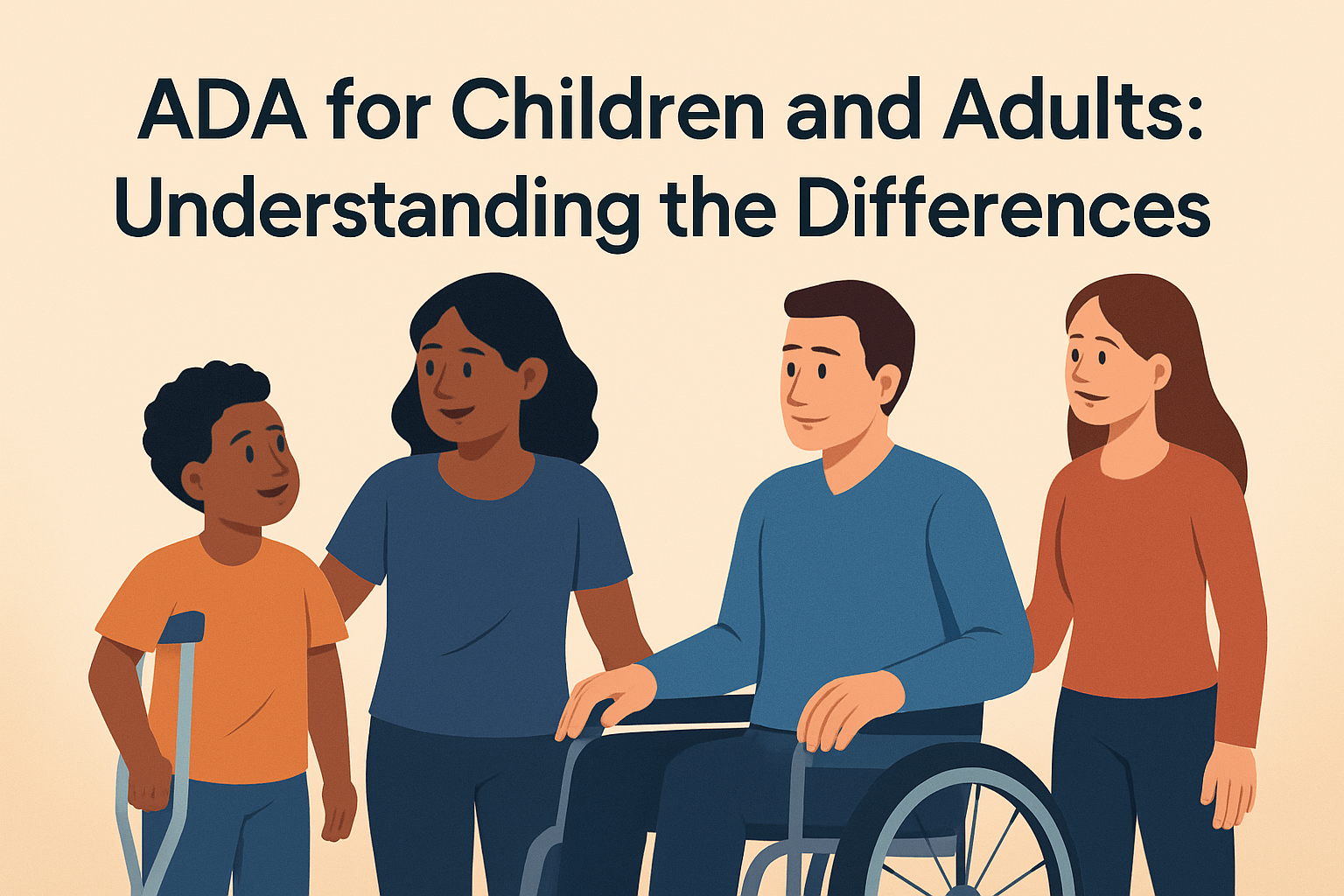
The Americans with Disabilities Act (ADA) is a crucial piece of civil rights legislation designed to eliminate discrimination against individuals with disabilities. Enacted in 1990, the ADA seeks to provide equal opportunities for people with disabilities in areas like employment, public accommodations, transportation, and government services. However, the application of the ADA can differ considerably between children and adults, due to the unique needs and environments they navigate. Understanding these differences is essential for educators, employers, policy makers, and families to create inclusive environments that cater to all ages.
Key terms such as “reasonable accommodation,” “individualized education programs (IEPs),” and “discrimination” frequently emerge when discussing ADA compliance. Reasonable accommodation refers to modifications or adjustments necessary for individuals with disabilities to perform essential functions or access facilities. IEPs are plans developed to ensure that children with disabilities receive specialized education tailored to their specific needs. Discrimination, in this context, means treating someone less favorably because of their disability.
The need for clarity on how the ADA addresses children versus adults is critical. This distinction impacts not only legal compliance but also day-to-day interactions and opportunities for those with disabilities. Decision-makers can develop more effective policies and practices by appreciating the nuances of ADA in diverse age groups. In the sections that follow, we will dive deeper into the specific differences and implications for children and adults under the ADA framework.
Educational Accommodations: Bridging the Gap for Children
For children, the ADA complements several other educational mandates, such as the Individuals with Disabilities Education Act (IDEA) and Section 504 of the Rehabilitation Act. These laws collectively ensure that children with disabilities receive a free appropriate public education (FAPE) that is tailored to their unique needs. A primary focus is the development and implementation of Individualized Education Programs (IEPs), which specify special educational services and supports.
An example of how the ADA functions in educational settings can be seen in physical disabilities. Consider a student with a mobility impairment who cannot access the upper floors of his school because the building lacks an elevator. The ADA requires that schools provide reasonable accommodations, such as installing an elevator or offering classes on the ground floor, to ensure the student’s integration into the mainstream school environment.
The process of accommodating children involves collaboration between parents, educators, and various specialists to develop effective IEPs or 504 Plans. This collaborative approach enables schools to address unique challenges, such as sensory issues or learning disabilities, which might require adapted learning materials or specialized instruction.
Workplace Accommodations for Adults: Ensuring Equal Employment Opportunities
When it comes to adults, particularly in the workforce, the ADA takes a different approach. The primary objective here is to prevent employment discrimination and provide equal opportunities. Under Title I of the ADA, employers with 15 or more employees are required to make reasonable accommodations for qualified individuals with disabilities. This means modifying workspaces, adjusting schedules, or providing assistive technology to enable employees to perform essential duties.
A real-world example could involve an office worker with a visual impairment. A reasonable accommodation might include the provision of screen reader software or modification of work documents to be accessible. Employers are also encouraged to engage in an interactive process with employees to identify suitable accommodations based on individual needs.
By fostering an inclusive workplace, organizations not only comply with the law but also benefit from a diverse workforce and enhanced company culture. However, employers are not required to make accommodations that result in undue hardship, often defined by factors such as cost or fundamental alteration to business operations.
Public Facilities and Access for All Ages
The ADA emphasizes accessibility in public facilities, benefiting both children and adults. Title II and Title III of the ADA govern state and local government services and public accommodations, respectively. These regulations ensure that individuals with disabilities can access public spaces, restaurants, theaters, and recreational facilities.
A common challenge addressed by the ADA is the need for accessible parking spaces and entrances for individuals using wheelchairs. A practical example is a city park that installs ramps and accessible playground equipment to cater to children with mobility limitations. Similarly, adults benefit from accessible seating options and entry ramps at public venues.
The ADA’s influence extends to transportation services, requiring that public transit systems accommodate individuals with disabilities. This includes ensuring buses are equipped with lifts or ramps and drivers are trained to assist.
Challenges and Solutions in Healthcare Access
Healthcare is another critical area where the ADA impacts both children and adults. Ensuring that individuals with disabilities receive appropriate medical care without discrimination is vital. Healthcare facilities must provide accessible medical equipment, clear communication methods, and trained staff to address diverse needs.
- Children with disabilities may require pediatricians to employ adaptive communication methods during appointments.
- Adults might need accessible examination tables or alternative formats for medical documentation.
Healthcare providers face challenges in balancing resource limitations with ADA compliance. Nonetheless, solutions like using telemedicine and adaptive devices help bridge the gap in service delivery, promoting equity in healthcare access for all ages.
The Role of Advocacy and Continued Progress
While the ADA provides a solid framework for ensuring rights for individuals with disabilities, continued advocacy is essential for ongoing progress. Organizations, families, and individuals must work together to raise awareness, identify gaps in services, and propose solutions that further enhance accessibility for children and adults alike.
An inspiring example of advocacy in action is that of an advocacy group partnering with a local government to implement tactile pathways in city centers. These pathways enable individuals with visual impairments to navigate public spaces safely. Similarly, parent-led initiatives have successfully lobbied for more inclusive playgrounds in schools and communities.
Public awareness campaigns, community workshops, and collaboration with policymakers hold the key to ensuring that the ADA evolves to meet modern demands effectively. By fostering an environment of acceptance and understanding, society can support individuals with disabilities in reaching their full potential.
Summary and Steps Forward
The Americans with Disabilities Act serves as a vital tool in promoting equality for individuals with disabilities across all age groups. The differences in its application for children and adults highlight the need for tailored approaches in various settings, such as education, employment, public facilities, and healthcare. These distinctions ensure that both children and adults receive the support and accessibility they need to thrive.
Key takeaways include understanding the role of IEPs in education for children, recognizing the importance of workplace accommodations for adults, and appreciating the significance of accessible public and healthcare services. By remaining informed and proactive, policymakers, educators, employers, and families can collectively foster a more inclusive environment.
As the world evolves, so too must our approaches to accessibility. Embracing technological advancements and advocating for continuous improvement is essential. Those inspired by the principles of the ADA are encouraged to engage with local organizations, participate in advocacy efforts, and contribute to a society where every individual, regardless of age or ability, is valued and supported.
In conclusion, understanding and implementing the ADA’s provisions for both children and adults not only uphold legal responsibilities but also enrich communities and enhance equality and opportunity for all.
Frequently Asked Questions
1. How does the ADA differ in its application to children compared to adults?
The Americans with Disabilities Act (ADA) applies to both children and adults, but there are distinct differences in how it is implemented for these two groups. For children, especially those in the educational system, the ADA intersects significantly with the Individuals with Disabilities Education Act (IDEA) and Section 504 of the Rehabilitation Act. These laws ensure that children with disabilities receive free appropriate public education (FAPE) in the least restrictive environment. This means schools are required to provide necessary accommodations, modifications, and services to meet the needs of children with disabilities, helping them to learn alongside their non-disabled peers to the greatest extent possible.
In contrast, the application of the ADA for adults often focuses more on employment, accessibility, and public accommodations. The law protects adults from discrimination in workplaces and requires businesses and public spaces to be accessible. This might include modifications like wheelchair ramps, accessible restrooms, or workplace adjustments that ensure an equal opportunity to perform job duties or participate fully in community life. Recognizing these differences is vital because the contexts in which they apply are inherently distinct, with schools functioning as both educators and care providers for children, while workplaces may deal mainly with job performance and access.
2. What specific accommodations might be made for children under the ADA?
For children covered under the ADA, accommodations are often about ensuring access to education and the school environment. Examples include modifying classroom setups for accessibility, providing assistive technology like speech-to-text software, and granting additional time for tests. Other accommodations might involve specialized services such as speech therapy or occupational therapy, tailored to meet the individual needs of the child.
Beyond the classroom, accommodations also extend to extracurricular activities and school transportation. For instance, a child with a mobility impairment might be provided with accessible transportation to and from school or given priority seating in a school auditorium. These adjustments are crafted to remove barriers and ensure that children with disabilities can engage in the same educational experiences as their peers, without facing discrimination.
3. How does the ADA support adults in the workplace?
The ADA plays a crucial role in creating fair employment opportunities for adults with disabilities, mandating that employers with 15 or more employees provide reasonable accommodations to qualified individuals. This means that workplaces might have to implement changes such as modifying work schedules, restructuring jobs, or acquiring assistive devices to help an employee perform essential functions.
Furthermore, the ADA prohibits discrimination in hiring, promotions, and other employment aspects. So, for adults, the ADA ensures they are judged by their qualifications and capabilities rather than their disabilities. It also requires that job interviews or employment tests be accessible, allowing individuals with disabilities to showcase their qualifications on equal footing with other candidates.
4. What role does the ADA play in accessing public transportation for both children and adults?
The ADA is instrumental in ensuring that public transportation systems are accessible to both children and adults with disabilities. This means that public transit buses, trains, and stations must include features like ramps, elevators, priority seating, and clearly marked accessible routes to accommodate passengers with various needs. Children who use school-related transportation services also benefit from these requirements, guaranteeing that getting to school or a school-related event is not a barrier.
For adults, these ADA requirements mean that commuting to work or traveling within the community does not become an insurmountable hurdle. Transportation providers must also provide Paratransit services for those unable to use fixed-route public transit, ensuring equitable access to mobility. This parity helps integrate individuals with disabilities into all community aspects, reducing isolation and promoting independence.
5. How does the ADA address issues in public accommodations differently for children and adults?
Public accommodations cover facilities such as restaurants, hotels, theaters, and recreational facilities. For children, access to these spaces often relates to their capacity to participate in extracurricular activities, sports, or social events. Under the ADA, these places are required to accommodate children with disabilities, thus ensuring that they can join in with their peers in activities like birthday parties, sports leagues, or community programs.
For adults, public accommodations ensure that everyday tasks, like dining out or attending cultural events, are accessible. Facilities must remove barriers where possible or provide alternative access methods, such as allowing service animals or making structural changes when necessary. Public accommodations involve creating an inclusive environment where both children and adults with disabilities can socialize, explore, and enjoy the full range of experiences offered by their communities.