Skip to content

KNOW-THE-ADA

Resource on Americans with Disabilities Act

  • Overview of the ADA
  • ADA Titles Explained
  • Rights and Protections
  • Compliance and Implementation
  • Legal Cases and Precedents
  • Toggle search form

Title III

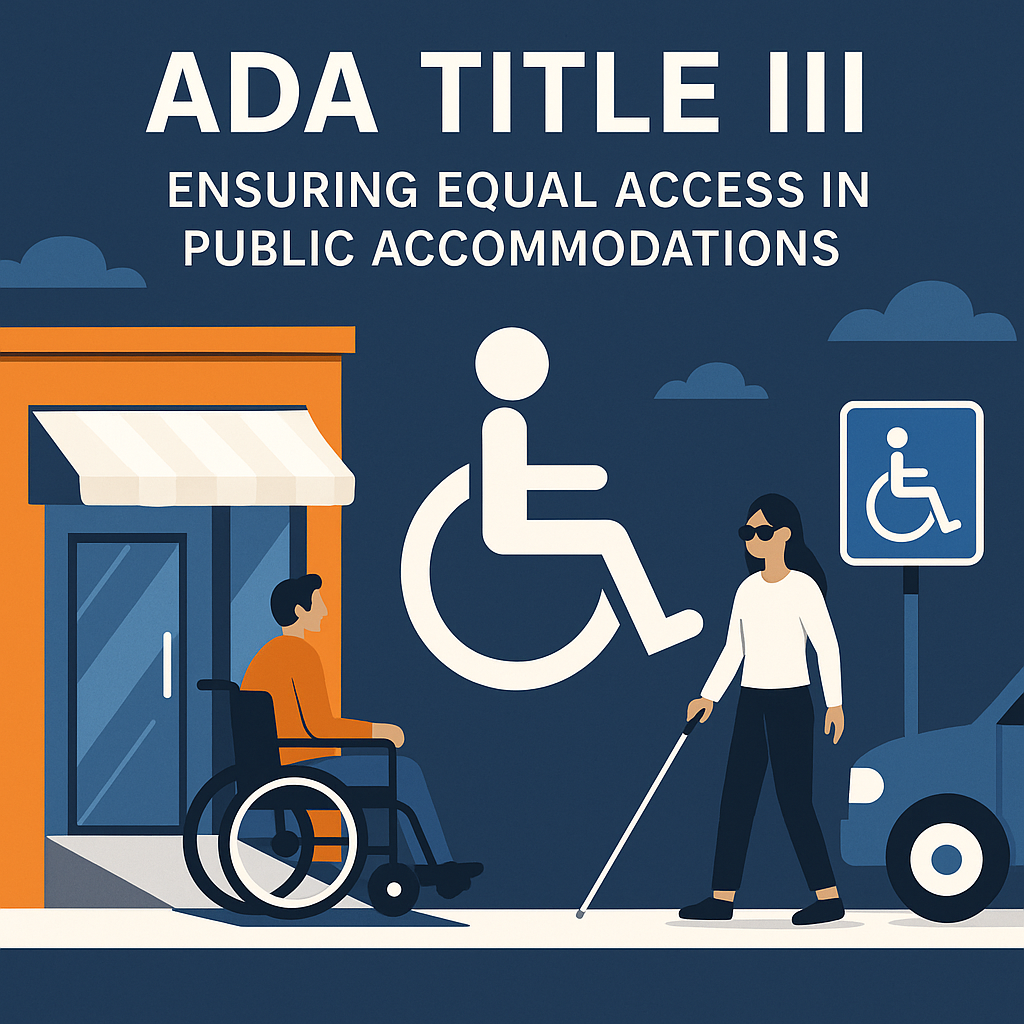
The Americans with Disabilities Act (ADA) is one of the most important civil rights laws in U.S. history. Enacted in 1990, it prohibits discrimination based on disability and promotes inclusion in all aspects of public life. Among its five titles, Title III holds businesses and public institutions accountable by mandating that people with disabilities must have equal access to public accommodations.

Whether it’s a hotel, grocery store, movie theater, bank, or doctor’s office—Title III ensures that physical barriers, discriminatory policies, and digital inaccessibility don’t stand in the way of equal participation.

This guide explores everything you need to know about ADA Title III—from its legal framework and accessibility requirements to digital compliance, best practices, enforcement mechanisms, and the evolving legal landscape.


What Is ADA Title III?

Title III of the ADA prohibits discrimination based on disability in the full and equal enjoyment of goods, services, facilities, privileges, advantages, or accommodations of places of public accommodation, commercial facilities, and certain private entities offering exams or courses.

The Scope of Title III

Title III applies to:

  • Public accommodations (e.g., restaurants, hotels, stores, theaters, gyms, doctors’ offices, schools)

  • Commercial facilities (e.g., office buildings, factories)

  • Transportation depots (e.g., bus and train stations, but not airplanes)

  • Private entities offering educational/testing services (e.g., LSAT, GRE, licensing boards)

Importantly, Title III only applies to private entities. Government programs and services are covered under Title II.


Who Is Protected Under Title III?

ADA Title III protects qualified individuals with disabilities, defined as those who:

  • Have a physical or mental impairment that substantially limits one or more major life activities,

  • Have a record of such an impairment, or

  • Are regarded as having such an impairment (even if they do not actually have one)

Examples include individuals who are blind, deaf, use wheelchairs, have autism, diabetes, epilepsy, intellectual disabilities, PTSD, and many others.


Requirements for Public Accommodations

1. Equal Access and Nondiscrimination

Businesses must provide goods and services in an integrated setting to the greatest extent possible. Individuals with disabilities must be able to access these goods and services without being segregated or treated differently unless doing so is necessary for accessibility.

2. Removal of Architectural Barriers

Existing facilities must remove architectural barriers when it is readily achievable—meaning easily accomplishable without much difficulty or expense.

Examples of barrier removal:

  • Installing ramps

  • Making entrances and doorways wider

  • Adding grab bars in restrooms

  • Lowering counters

  • Rearranging furniture

New constructions and significant renovations must be fully compliant with ADA Accessibility Guidelines (ADAAG) from the outset.

3. Effective Communication

Title III requires that public accommodations communicate effectively with individuals who have hearing, vision, or speech disabilities.

This may require the provision of:

  • Qualified sign language interpreters

  • Real-time captioning services

  • Braille menus or tactile signage

  • Digital accessibility tools

  • Written materials in large print or accessible digital formats

The obligation is to ensure that communication is as effective for people with disabilities as it is for others.

4. Modification of Policies and Practices

Public accommodations must make reasonable modifications to policies, practices, and procedures when necessary to avoid discrimination.

Examples:

  • Allowing service animals where pets are normally not allowed

  • Modifying “no food” policies for people with diabetes

  • Offering curbside assistance to a customer with limited mobility

Businesses are not required to make modifications if doing so would fundamentally alter the nature of the service.


Digital Accessibility Under Title III

While the original 1990 law didn’t contemplate the internet, courts and the Department of Justice (DOJ) have increasingly interpreted Title III to apply to websites and digital platforms, especially for businesses with physical locations.

Key Requirements

  • Websites must be navigable via keyboard

  • All images must include alt text

  • Forms must be accessible via screen readers

  • Videos must have captions or transcripts

  • Sites must avoid color schemes that exclude users with colorblindness

Legal Precedents

Several lawsuits (notably against Domino’s Pizza, Winn-Dixie, and Harvard University) have set the expectation that businesses must ensure their websites and apps are accessible under WCAG 2.1 Level AA standards.


Compliance Obligations for Businesses

Title III does not require businesses to take on undue burden or expenses, but it does require them to do what’s readily achievable. Ignorance of the law or fear of cost is not a defense.

Businesses Must:

  • Conduct regular accessibility audits (physical and digital)

  • Train staff on ADA compliance and etiquette

  • Make reasonable accommodations upon request

  • Respond promptly to accessibility-related complaints

Exemptions

  • Religious organizations are generally exempt

  • Private clubs not open to the public may also be exempt

  • Undue burden: Modifications that are too expensive or difficult relative to the business’s size and resources may not be required


Service Animals and ADA Title III

One of the most misunderstood provisions under Title III is the use of service animals.

Key Rules:

  • Only dogs (and in some cases miniature horses) qualify

  • Must be trained to perform a task related to the person’s disability

  • Businesses may only ask:

    • Is this a service animal required because of a disability?

    • What work or task has the dog been trained to perform?

  • Emotional support animals do not qualify under Title III

  • Service animals must be allowed in all areas open to the public


Enforcement and Legal Remedies

ADA Title III is enforced by the U.S. Department of Justice (DOJ), and lawsuits are often brought by private individuals or disability rights organizations.

How Enforcement Works

  • Individuals can file complaints with the DOJ

  • DOJ may launch an investigation or mediation

  • Private lawsuits may be filed in federal court

Note: Title III does not provide for monetary damages in private lawsuits—only injunctive relief (requiring the business to fix the issue) and attorneys’ fees. However, many businesses settle due to legal costs and reputational risk.


Real-World Examples of ADA Title III in Action

  • A restaurant installs a portable ramp and lowers a portion of its counter to make ordering accessible to wheelchair users.

  • A movie theater provides closed captioning devices and assistive listening systems.

  • A retail website updates its design to meet WCAG 2.1 accessibility guidelines after being sued for screen reader incompatibility.

  • A yoga studio allows a participant with PTSD to bring a trained service dog into all classes.


Common ADA Title III Violations

Here are some of the most common violations seen in enforcement actions and lawsuits:

ViolationImpact
Steps at entrance with no rampBlocks access for wheelchair users
No accessible parkingPrevents independent entry to the business
Lack of assistive listening devicesDiscriminates against hard-of-hearing patrons
Online forms that don’t work with screen readersExcludes blind customers from online services
Failure to accommodate service animalsDenies access to qualified individuals
 

How to Achieve and Maintain Compliance

Physical Accessibility Checklist

  • At least one accessible entrance with ramp or lift

  • Doorways 32″ or wider

  • Accessible restroom with grab bars and clear space

  • Signage with braille and tactile text

  • 36″ minimum clear floor space in aisles

Digital Accessibility Checklist

  • Conform to WCAG 2.1 Level AA

  • Include alt text for all images

  • Ensure form labels are correctly coded

  • Use clear and simple language

  • Provide keyboard-only navigation


The Business Case for Accessibility

While Title III compliance is a legal necessity, it’s also good business. An estimated 61 million adults in the U.S. live with a disability. Accessibility opens your services to a larger market, improves customer experience, and reduces legal risk.

Benefits include:

  • Better SEO and web performance

  • Improved customer loyalty

  • Eligibility for government contracts

  • Enhanced brand reputation

  • Reduced risk of costly lawsuits or settlements


Conclusion

ADA Title III ensures that individuals with disabilities are not excluded from enjoying the same experiences and opportunities as everyone else—whether that means dining at a restaurant, shopping online, visiting a hotel, or seeing a doctor.

For businesses and public institutions, understanding and implementing Title III is not just a regulatory requirement—it’s a moral and social imperative.

With the right mindset, training, and tools, accessibility becomes less of a legal box to check and more of a competitive advantage and a community commitment.

Frequently Asked Questions

1. What is Title III of the Americans with Disabilities Act (ADA)?

Title III of the Americans with Disabilities Act (ADA) is a crucial part of the comprehensive civil rights law that was enacted in 1990 to prohibit discrimination based on disability and promote equal access across various domains. Specifically, Title III pertains to public accommodations. This means that businesses and facilities open to the public, such as hotels, restaurants, retail stores, movie theaters, and medical offices, must ensure their services and amenities are accessible to individuals with disabilities. Promoting inclusion and equality, Title III mandates the removal of architectural barriers in existing buildings where possible, and requires that new constructions and alterations to existing structures comply with accessibility standards. For example, if a new restaurant is being built, it must include features such as wheelchair-accessible entrances and restrooms. Overall, Title III is designed to ensure that people with disabilities can participate fully in public life by having equal opportunities to use and enjoy services provided by public entities.

2. Who is responsible for enforcing Title III of the ADA?

Enforcement of Title III of the ADA is primarily the responsibility of the U.S. Department of Justice (DOJ), which has the authority to investigate complaints of disability discrimination in public accommodations and take action to rectify violations. If you believe a business or public entity is not complying with Title III requirements, you can file a complaint directly with the DOJ. Furthermore, individuals have the right to bring a private lawsuit against the entity in question. However, pursuing legal action can be a complex and lengthy process, and it's often recommended that individuals consult with an attorney who specializes in disability rights. The DOJ also engages in outreach and provides technical assistance to help businesses understand their obligations under Title III, and works closely with local governments and advocacy groups to promote compliance. Implementing penalties for non-compliance can include fines and mandates for corrective actions, underscoring the responsibility entities have to create an inclusive environment for all community members.

3. What types of businesses are covered under Title III?

Title III of the ADA covers a broad array of public accommodations and commercial facilities. This includes, but is not limited to, places of lodging (such as hotels and motels), establishments serving food or drinks (like restaurants and bars), places of exhibition or entertainment (such as movie theaters and sports arenas), sales or retail establishments (such as grocery stores and shopping malls), service establishments (like banks, lawyers’ offices, pharmacies, hospitals, and doctor’s offices), public transportation terminals, and places of education. Essentially, Title III applies to any private entity that is open to the public and affects commerce, meaning most businesses that serve the public must comply with its provisions. Additionally, commercial facilities such as office buildings and factories, while not open to the public, must comply with Title III standards when newly constructed or significantly altered. The goal is to ensure these entities offer equitable access to people regardless of their physical abilities.

4. What are the accessibility requirements for existing facilities under Title III?

Under Title III of the ADA, existing facilities have specific obligations to improve accessibility. The ADA mandates that whenever it is "readily achievable" for the business or entity to remove barriers, it must do so. The term "readily achievable" means easily accomplishable and without much difficulty or expense, and depends on the size, type, and overall financial resources of the business. Examples of barrier removal include installing ramps, making curb cuts at sidewalks and entrances, repositioning shelves and tables, adding accessible door hardware, and creating designated accessible parking spaces. Additionally, businesses are required to ensure that goods and services are accessible through reasonable policies and practices. In situations where barrier removal is not readily achievable, businesses must provide access through alternative methods whenever possible. It's important to note that alteration projects, such as remodels or renovations at existing facilities must comply with ADA standards, meaning they should improve access and integrate accessible features unless technically infeasible.

5. How do new construction projects ensure compliance with Title III?

Compliance with Title III of the ADA for new construction projects involves adhering to specific accessibility standards outlined in the ADA Standards for Accessible Design. Any building first occupied after January 26, 1993, must conform to criteria that ensure the facility is usable by individuals with disabilities. This includes requirements for accessible entrances, doorways wide enough for wheelchairs, restrooms that accommodate various mobility challenges, signage with Braille and tactile characters, and emergency alarm systems that include both visual and auditory alarms. For construction projects, architects and builders must understand these standards to incorporate them into design plans right from the outset. It is crucial for new developments to conduct proper site evaluations and review ADA regulations to ensure full compliance and avoid costly modifications later on. Additionally, local building codes often supplement these federal requirements, necessitating thorough coordination between varying regulations. Overall, careful planning and execution of accessible design principles will help create an inclusive environment in compliance with Title III of the ADA.

Helpful Links

  • Title I
  • Title II
  • Title III
  • Title IV
  • Title V
  • The Ultimate Glossary of Key Terms for the Americans with Disabilities Act (ADA)

Copyright © 2025 KNOW-THE-ADA. Powered by AI Writer DIYSEO.AI. Download on WordPress.

Powered by PressBook Grid Blogs theme