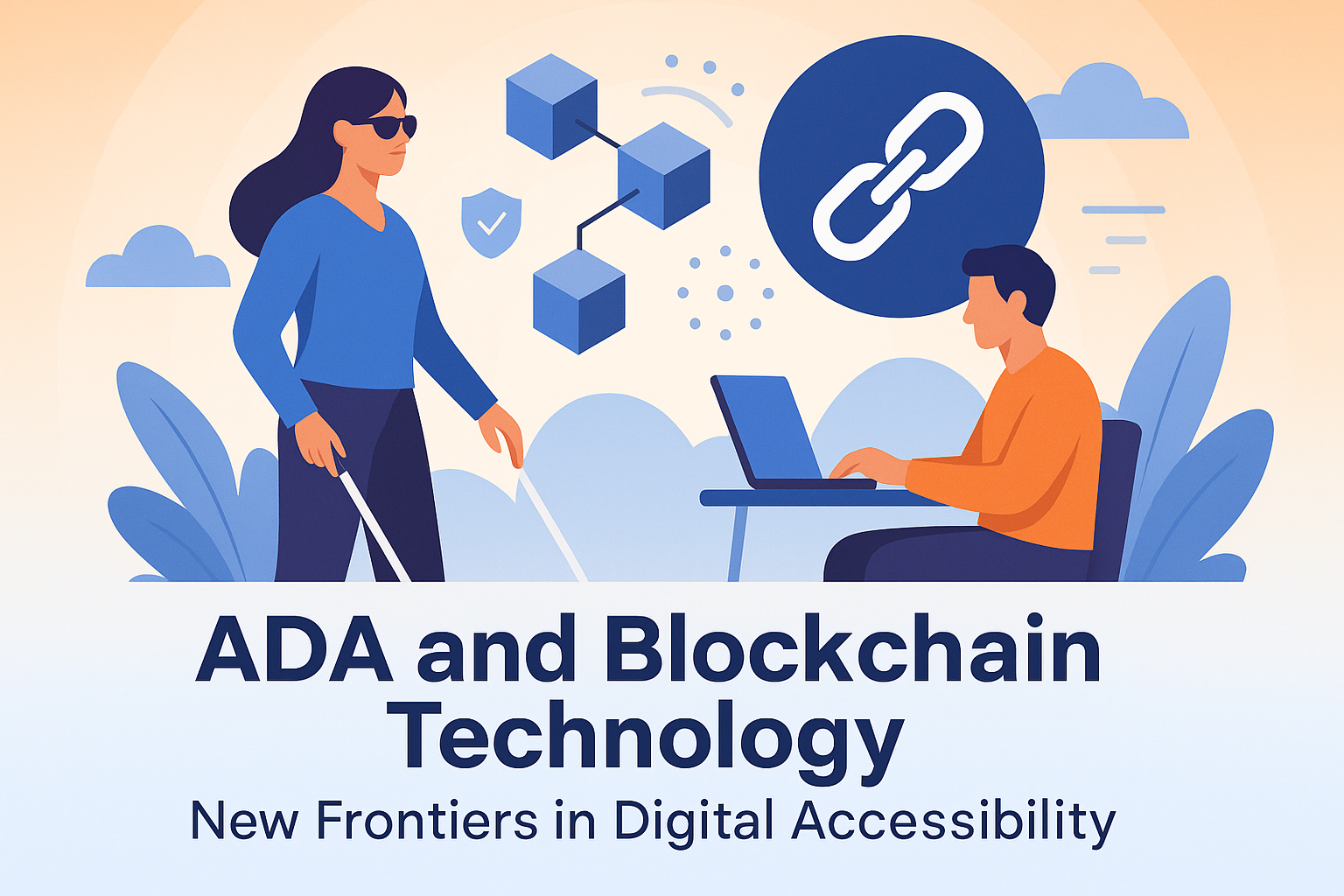
Digital accessibility is an ever-expanding frontier in our technology-driven world. The Americans with Disabilities Act (ADA) sets guidelines to ensure that all people, regardless of their disabilities, have equal access to digital resources. In recent years, blockchain technology has emerged as a groundbreaking solution, offering new ways to enhance ADA compliance in the digital sphere. Blockchain is a decentralized digital ledger that securely records transactions across multiple computers. It is best known for powering cryptocurrencies like Bitcoin, but its potential applications extend far beyond financial services. This article explores the intersection of ADA compliance and blockchain technology, illustrating how this combination offers a new level of inclusivity and security in digital accessibility.
The Importance of ADA in the Digital World
Originally enacted in 1990, the ADA was designed to promote accessibility and prevent discrimination against individuals with disabilities. As our world migrates online, compliance with ADA guidelines in digital environments, such as websites and applications, has become increasingly significant. Inaccessible digital content limits opportunities and societal participation for individuals living with disabilities. Simple tasks, like booking a flight or filling out a form, become insurmountable hurdles without ADA-compliant digital platforms.
A notable example of ADA in action can be seen in the case of Target Corporation. In 2008, Target faced a lawsuit for the inaccessibility of their website to visually impaired users. It resulted in a $6 million settlement and exemplified the growing requirement for companies to make their digital presence accessible to all. Blockchain technology can facilitate ADA compliance by ensuring transparency and fostering new tools and applications that augment accessibility.
Understanding Blockchain Technology
Blockchain technology is essentially a chain of blocks, where each block represents a set of transactions. These transactions are recorded and verified across a network of computers, ensuring that the data is tamper-proof and transparent. Blockchain’s decentralized nature means there is no single point of failure, making it more secure and robust than traditional centralized systems.
An example of blockchain’s utility in ensuring security and transparency is its implementation in supply chains. When products are tracked through a blockchain ledger, every stage of the supply chain is recorded and can be audited in real-time. This is analogous to how blockchain can be used to track and verify digital accessibility compliance efforts.
Blockchain and Digital Accessibility Solutions
The utility of blockchain technology in enhancing digital accessibility is extraordinarily promising. Using blockchain, new solutions can be developed to provide better access to digital platforms and resources for people with disabilities. Accessibility tools, user preferences, and compliance audits can all be stored on a blockchain, promoting transparency and ensuring verifiable accountability.
- Unified User Profiles: Blockchain can store personalized accessibility preferences, such as font size, contrast adjustments, or screen reader settings. When a person with disabilities accesses a new platform, their preferences load automatically, ensuring immediate accessibility.
- Digital Accessibility Verification: By storing and tracking ADA compliance certifications and audits on a blockchain, organizations can demonstrate their commitment to accessibility transparently.
A real-world implementation of these solutions could involve an educational institution using blockchain to maintain an updated registry of accessibility features available across its digital platforms, ensuring compliance with ADA standards and providing students with disabilities equal access to educational resources.
Case Study: Education Sector Integration
The education sector provides a fertile ground for implementing blockchain to improve digital accessibility. From online course materials to student portals, educational institutions must accommodate diverse learning needs. One community college in California piloted a blockchain-based system to manage accessibility compliance, significantly enhancing the learning experience for students with disabilities. Using blockchain, the college could instantly verify if their digital assets, like PDFs and videos, met accessibility standards.
The institution implemented a blockchain solution that stored results from automated accessibility checks. Educators and administrators could then quickly identify and rectify any accessibility gaps, ensuring compliance with ADA requirements. This integration not only improved access but also established a reliable process for maintaining digital inclusivity over time.
Challenges and Considerations
While the potential of blockchain to enhance digital accessibility is immense, it is not without challenges. For one, blockchain technology requires significant computational resources and technical expertise, which can be prohibitive for some organizations. Additionally, there is a need for standardization to ensure blockchain solutions are interoperable and universally acceptable.
Moreover, privacy concerns must be addressed, particularly when dealing with personal accessibility preferences or sensitive compliance data. Blockchain’s inherent transparency, which ensures security, can sometimes clash with privacy requirements. Thus, it is critical to balance transparency with the need for confidentiality carefully.
Future of Blockchain in Accessibility
Looking ahead, blockchain’s integration into digital accessibility is poised to grow exponentially. As more sectors realize the benefits of secure and transparent systems, the demand for blockchain solutions will likely increase. Innovations such as decentralized applications (dApps) can lead to even greater accessibility improvements. These applications can be built on blockchain platforms to perform specific functions—like verifying the accessibility compliance of a website or digital resource autonomously.
The potential is vast, with blockchain providing new tools that redefine how organizations approach ADA compliance and support people with disabilities. Partnerships between tech companies and advocacy groups are essential to harness blockchain’s full potential in enhancing accessibility efforts. The ongoing dialogue between these stakeholders could forge innovative pathways toward a digital world where inclusivity is the standard rather than the exception.
Conclusion: Embracing Blockchain for a More Accessible Future
In conclusion, the intersection of ADA compliance and blockchain technology presents a revolutionary approach to ensuring digital accessibility. By leveraging blockchain’s transparent and secure framework, organizations can enhance compliance with ADA standards and better serve individuals with disabilities. Key takeaways include blockchain’s potential to facilitate the automation of accessibility checks, store personalized user preferences, and maintain thorough compliance audits.
For readers involved in digital accessibility endeavors, the adoption of blockchain technology offers a promising avenue to explore. Start by assessing your organization’s current accessibility measures and considering how a blockchain-based solution could align with your goals. As blockchain technology continues to evolve, staying informed and involved in this space can empower individuals and organizations to contribute to a more inclusive digital world.
By embracing these technological advancements, we can create an accessible digital landscape where everyone, regardless of ability, engages with technology on equal terms, paving the way for societal progress and innovation in accessibility realms.
Frequently Asked Questions
1. What is the relationship between ADA compliance and blockchain technology?
The Americans with Disabilities Act (ADA) is fundamentally about ensuring equal access to opportunities and resources for everyone, including those with disabilities. As our work, commerce, and social interactions increasingly shift to digital platforms, digital accessibility has become vital. ADA compliance in the digital realm means websites, mobile apps, and other electronic platforms must be usable by individuals with various disabilities. This includes considerations such as screen readers for the visually impaired, closed captioning for the hearing impaired, or ensuring that interactive elements can be navigated using a keyboard for those who cannot use a mouse.
Blockchain technology offers unique solutions to enhance digital accessibility. Being a decentralized digital ledger, blockchain records transactions across multiple computers in a secure manner. This decentralization means that information stored on a blockchain can be more easily audited and verified without reliance on a central authority. For ADA compliance, blockchain can improve transparency and accountability, allowing organizations to document accessibility audits and compliance measures effectively. Additionally, smart contracts on the blockchain can be programmed to automatically enforce ADA compliance by only executing transactions that meet digital accessibility standards.
2. How can blockchain technology proactively ensure accessibility in digital platforms?
Blockchain technology can play a proactive role in ensuring digital accessibility by embedding standard protocols into the development and deployment of digital applications. For example, using blockchain, a platform can log every digital content change while tracking compliance with accessibility standards. This can include documenting the use of alt text for images, ensuring content is navigable without a mouse, or verifying that video content includes captions or audio descriptions.
Moreover, when developing digital products, developers can employ blockchain to create immutable records of accessibility checks conducted by auditors or accessibility experts. This transparency not only encourages adherence to ADA standards but also simplifies the process of identifying and rectifying accessibility gaps over time. In essence, blockchain can be the backbone of an open, transparent system where compliance is consistently documented and enhanced, offering a trustless process where all stakeholders can rely on the records captured.
3. What are some real-world examples of blockchain enhancing ADA compliance?
While the integration of blockchain with ADA compliance is still in its early stages, several pioneering efforts demonstrate its potential. One prominent example is the use of blockchain in educational institutions. As colleges and universities strive to offer accessible online education, blockchain can help ensure that course materials, such as lecture videos, PDFs, and interactive content, meet ADA standards by providing a transparent ledger of compliance checks and making these checks available for auditing.
Another example is in the world of online marketplaces. Blockchain technology can facilitate the verification that products and services meet accessibility requirements. For instance, an online store could use blockchain to certify that its website adheres to Web Content Accessibility Guidelines (WCAG), providing a verifiable trail of compliance efforts to attract customers who prioritize accessibility.
4. Can blockchain be used to create accessible cryptocurrencies or payment systems?
Certainly, blockchain can enhance the accessibility of cryptocurrencies and digital payment systems for individuals with disabilities. With traditional payment systems and digital wallets, accessibility features may be limited or inconsistently applied. However, using blockchain, cryptocurrency developers can incorporate ADA-compliant features directly into the cryptocurrency protocols and digital wallets.
This might include accessible interfaces for screen readers, voice command capabilities, and keyboard navigation options within cryptocurrency wallets and decentralized applications (dApps). Additionally, blockchain is inherently secure and encrypted, which provides more confidence and independence to users with disabilities when conducting financial transactions without the need for third-party assistance.
5. What are the challenges or limitations of using blockchain for ADA compliance?
While blockchain offers promising advances in ADA compliance, there are certain challenges and limitations to be mindful of. One of the foremost obstacles is the complexity of the technology itself. Blockchain can be difficult for some organizations to implement due to a lack of knowledgeable personnel or resources, which may hinder its widespread adoption for accessibility purposes.
Additionally, while blockchain can support the enforcement and verification of accessibility standards, it cannot achieve accessibility goals alone. Traditional accessibility practices, such as user testing with people who have disabilities, continuous audits, and the development of inclusive designs, are crucial to achieving a truly accessible digital experience. Blockchain can enhance these efforts, but it is not a substitute for comprehensive accessibility strategies.
Furthermore, the immutability of blockchain, while typically an asset, can be a limitation when rapid changes or updates are needed to improve accessibility, as each change needs to be permanently logged and verified. Despite these challenges, the potential benefits of blockchain technology in advancing digital accessibility and ADA compliance are significant and cannot be overlooked as we consider the future of digital inclusivity.