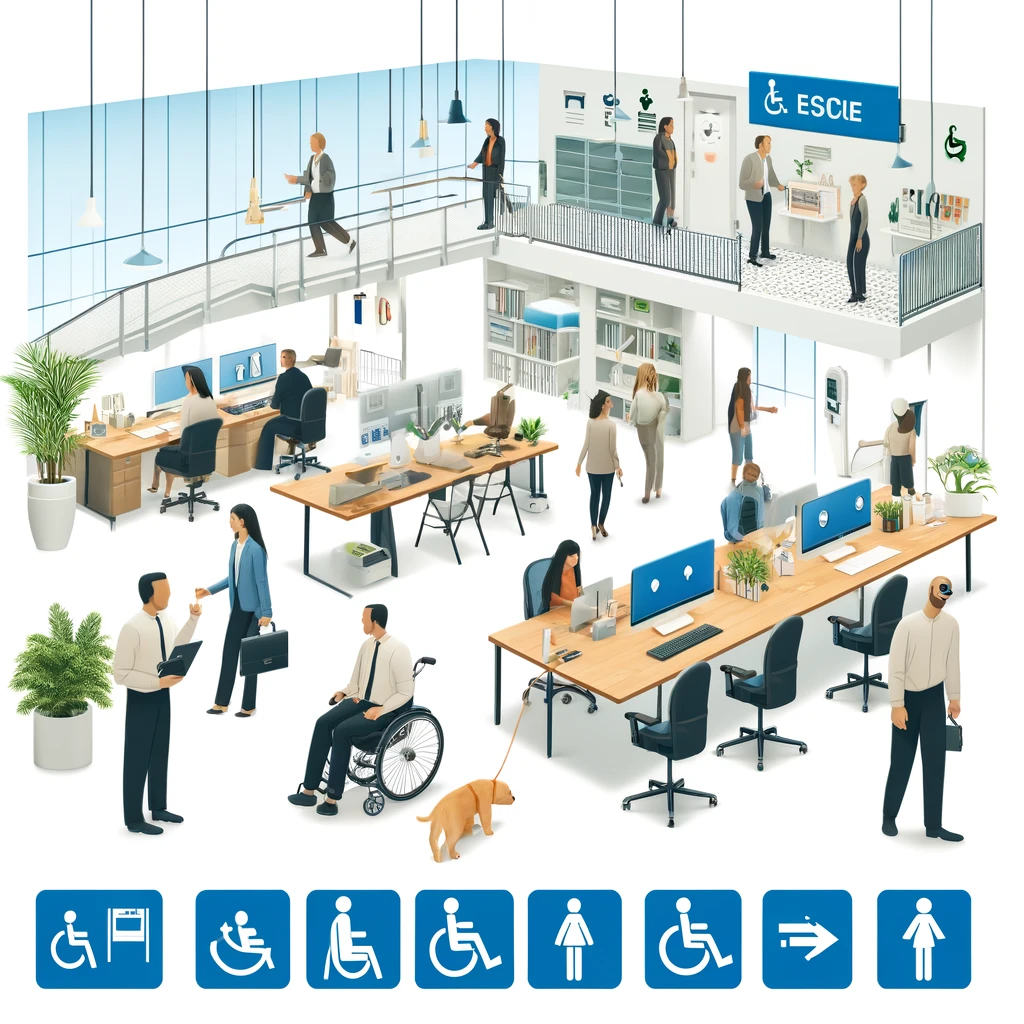
In today’s evolving modern landscape, accessibility isn’t just a buzzword; it’s a significant, essential component of creating equitable environments. Providing equitable access is especially crucial in public spaces, which should be accessible to everyone, including people with disabilities. To this end, the Americans with Disabilities Act (ADA) establishes comprehensive requirements to ensure accessibility in all public arenas. The ADA’s meticulous guidelines address a wide range of physical and digital spaces, making it imperative for architects, urban planners, and facility managers to comprehend and apply these regulations effectively. Compliance with ADA ensures not only legal adherence but also fosters inclusivity and enhances the quality of life for individuals with disabilities. This article serves as a detailed guide to understanding the ADA’s accessibility mandates for public spaces, providing insights and practical advice for planning and implementing inclusive environments. Embracing the ADA’s guidelines propels us toward a more inclusive society, recognizing the importance of equal access in bolstering independence and dignity for people with disabilities.
Understanding ADA Accessibility Requirements
The Americans with Disabilities Act stipulates uniform accessibility standards to remove barriers for individuals with disabilities. Understanding these requirements is essential for planning public spaces. For effective compliance, one must comprehend the scope, applicability, and specific measures mandated by the ADA.
Firstly, recognize that the ADA mandates comprehensive accessibility in all public areas, including transportation facilities, parks, recreational venues, commercial entities, and governmental buildings. This wide-ranging applicability underscores the importance of accessibility in every aspect of public life. It extends beyond just physical spaces to include digital environments, ensuring that websites, software, and digital interfaces are accessible.
The ADA’s guidelines cover various aspects such as building accessibility, including doorways, ramps, elevators, bathrooms, and signage. They specify the dimensions, installation heights, and requirements for space maneuverability, which are based on detailed research to accommodate a wide range of disabilities. For instance, doorways must be wide enough to allow wheelchair access, and there should be tactile or auditory signage for individuals with visual impairments.
Moreover, the ADA outlines specific requirements for elements like parking, seating, public telephones, water fountains, and emergency exits. ADA compliance also entails the adjustment of policies, practices, and procedures to accommodate people with disabilities adequately. This involves training employees to assist individuals with disabilities and ensuring that communication is effective, which may include providing interpreters, alternate formats, or communication devices.
Creating Physical Space Accessibility
When designing accessible physical spaces, attention to detail is crucial. This entails evaluating pathways, entryways, seating arrangements, and emergency exits to cater to diverse mobility and sensory needs. Ramps and curb cuts are essential to facilitate smooth transitions for wheelchair users and those with mobility challenges. According to ADA guidelines, ramps must have a gradient no steeper than 1:12, providing adequate landing spaces on both ends for maneuverability.
Doors should be effortless to open, with lever-style handles preferred over doorknobs for easy operation by those with limited hand dexterity. Ensuring the threshold is not more than ½ an inch high avoids barriers for wheelchairs. Entryway width is critical, with a minimum of 32 inches of clear passageway required for accessibility.
Inside buildings, providing ample space for wheelchair turning is essential. A diameter of at least 60 inches is recommended for easy maneuvering in circles. Public venues must also cater to those with visual and auditory impairments. Installing braille and tactile signs at eye level for those using canes is a necessity, ensuring they are positioned next to doors rather than directly on them. Incorporating audible signals at pedestrian crossings and building exits enhances safety and navigation for those with visual impairments.
Elevators are imperative in multi-story buildings. Elevator controls should be accessible from a seated position, with both braille and raised numbers on keypads. Emergency communication systems should not rely solely on audio but provide visual means as well, catering to individuals with hearing impairments.
Digital Accessibility in Public Spaces
Digital accessibility is an evolving area under ADA’s purview, increasingly crucial in our technology-driven society. Websites and digital kiosks in public spaces must adhere to the ADA standards, ensuring functionality for all, including those with visual, auditory, motor, or cognitive disabilities. Ensuring digital accessibility entails adhering to the Web Content Accessibility Guidelines (WCAG), specifying standards for text alternatives for non-text content, captioning for multimedia, and keyboard navigation capabilities.
Digital touchpoints such as kiosks in train stations, libraries, and museums should be navigable through screen readers, ensuring that individuals with visual impairments can access information seamlessly. Additionally, these interfaces should support assistive technologies like speech recognition and touch sensitivity, catering to users with limited hand mobility.
Electronic documentation, often used for forms and informational pamphlets in public offices, should be accessible in multiple formats. Incorporating features like resizable text, high-contrast modes for easier reading, and simplified language for cognitive accessibility ensures inclusivity.
Training and Policies for Effective Implementation
Compliance with ADA guidelines goes beyond physical and digital accommodations. Training staff to understand, recognize, and address the needs of individuals with disabilities is paramount. Periodic training sessions should focus on sensitivity, communication methods, and emergency response suited for assisting those with disabilities.
Policies should encourage and facilitate accommodations, emphasizing flexible service offerings, such as allowing service animals, providing sign language interpreters, or offering printed material in alternative formats like braille and audio. Staff should be proactive, offering assistance when necessary while respecting the independence and dignity of individuals with disabilities.
Emergency preparedness is another critical component. Ensuring that emergency plans include provisions for evacuating individuals with disabilities is crucial, whether through specialized equipment or designated rescue assistance areas. Regular drills should include scenarios addressing these scenarios, with input and participation from individuals with disabilities.
Case Studies and Practical Applications
Reflecting on examples of successful ADA implementation provides valuable insights. Numerous cities have revamped their transportation networks to comply with ADA, introducing low-floor buses, priority seating, and audible stops, which exemplify the fusion of accessibility and efficiency. Municipal buildings have adopted tactile paving, contrasting colors for improved visibility, and induction loop technology for individuals with hearing aids.
Recreational spaces have also made strides, with playgrounds featuring inclusive swings and slides, as well as sports facilities offering adaptive equipment for athletes with disabilities. Museums have introduced audio tours, tactile exhibits, and sign language guides, fostering immersive and inclusive experiences.
Even smaller-scale initiatives can have a significant impact. Restaurants incorporating menu options in braille or businesses training staff in basic sign language improve accessibility. By fostering a culture of inclusivity and accessibility, communities not only comply with legal obligations but enrich their collective civic life.
Conclusion
As societal awareness grows, the implementation of ADA accessibility guidelines in public spaces becomes increasingly imperative. By understanding and applying these comprehensive standards, we ensure equitable access and inclusivity, leading to environments where individuals with disabilities can thrive and participate fully in public life. The commitment to accessibility transcends mere compliance; it represents a dedication to recognizing and valuing diversity.
Designing spaces that accommodate all facets of the population requires careful planning, sensitivity, and innovation. It calls on designers, policymakers, and the community alike to invest in creating environments that are not only compliant but welcoming and empowering for everyone. As we advance technologically, emphasis on digital accessibility becomes crucial, underscoring the need for continuous evaluation and adaptation.
Ultimately, embracing ADA guidelines not only benefits individuals with disabilities but enhances the community as a whole, fostering unity and understanding. By prioritizing accessibility, we pave the way for a more inclusive, harmonious, and forward-thinking society, where barriers are removed, and opportunities are accessible to all.